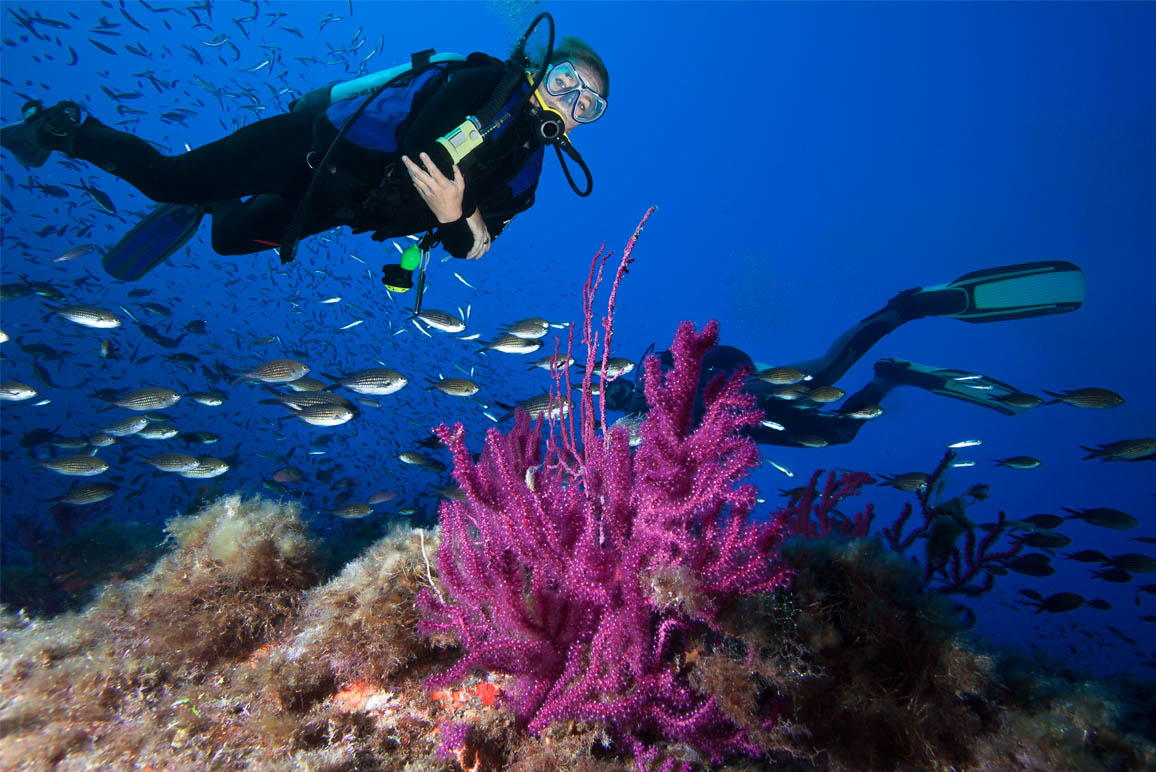
South Corsica is a dream destination for scuba diving enthusiasts. Its crystal-clear waters, among the clearest in the Mediterranean, conceal hidden treasures and exceptional biodiversity that promise unforgettable immersions.
Far from the hustle and bustle of land, the underwater world of southern Corsica offers a breathtaking spectacle where nature has preserved its rights. From dizzying drop-offs to mysterious wrecks, underwater canyons and posidonia meadows teeming with life, every dive is a unique adventure.
Get ready to discover seabeds that will literally take your breath away, and understand why diving in Southern Corsica is a must-do experience.
The Bouches de Bonifacio Nature Reserve: An Underwater Sanctuary
An Exceptionally Rich Protected Ecosystem
The Bouches de Bonifacio Nature Reserve is the jewel in the crown of diving in Southern Corsica. Spanning 80,000 hectares, it is the largest marine reserve in mainland France, an area where environmental protection has enabled underwater life to flourish spectacularly.
To dive here is to enter a veritable natural aquarium, where Mediterranean flora and fauna unfold in all their diversity and abundance. The clarity of the water, often in excess of 30 metres, enhances the experience, allowing you to fully appreciate the colors and details of this underwater world.
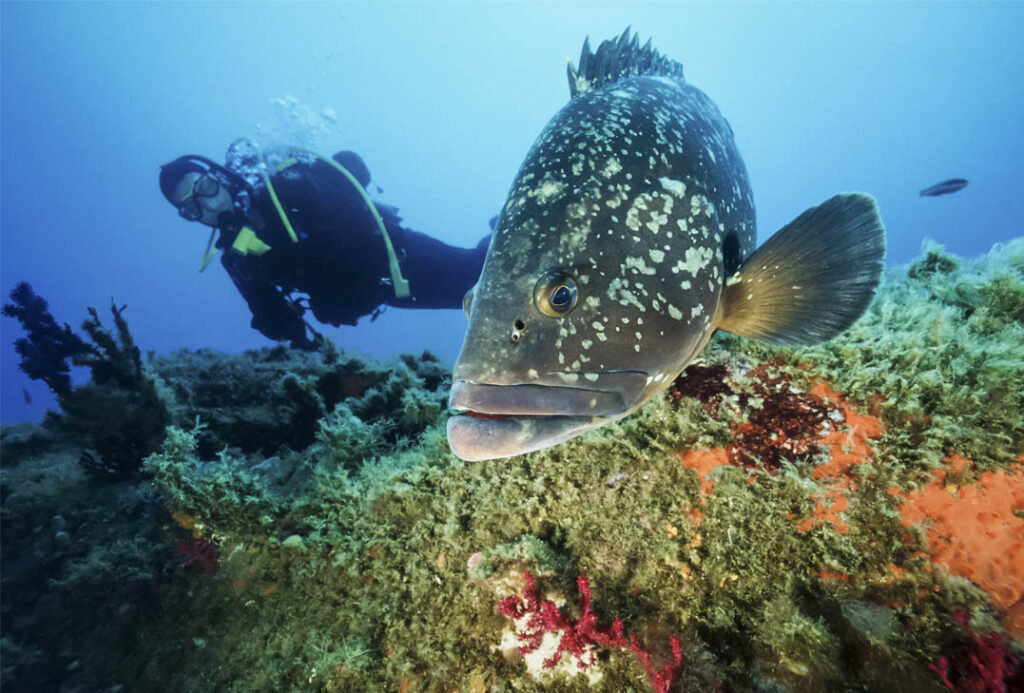
The effectiveness of the protection measures put in place, reinforced by the 2024-2029 management plans, is reflected in a remarkable density of fish. Brown groupers, emblems of the reserve, are particularly numerous and shy, offering divers fascinating close encounters.
Schools of dentex, barracuda and sars are also common, as are a multitude of rock species such as moray eels, conger eels and capons. Posidonia meadows, veritable underwater meadows, are essential nursery areas and home to an abundance of life, from discreet seahorses to protected large nacres.
Diving in the reserve also means becoming aware of the fragility of these ecosystems and the importance of preserving them. Local dive centers play a vital role in raising visitor awareness, reminding them of the strict rules that apply (no fishing, no feeding, no sampling, regulated anchorage zones).
This respectful approach guarantees the site’s longevity and enables every diver to enjoy an authentic experience in the heart of unspoilt nature.
The biological richness of this reserve makes it an ideal study site for scientists tracking the evolution of marine populations in the face of climate change, as highlighted in several publications by the Corsican Environment Office dating from 2024.
The Lavezzi Islands: An Underwater Granite Labyrinth
At the heart of the Nature Reserve, the archipelago of the Lavezzi Islands is a must-see diving spot in Southern Corsica. This group of granite islets, located halfway between Corsica and Sardinia, is famous for its spectacular rock formations, both above and below the surface.
Underwater, these erosion-polished granite boulders create a unique underwater landscape of arches, canyons, tunnels and scree where marine life abounds. The shallowness of many sites (often between 10 and 25 meters) makes exploration accessible to most levels of diver, while benefiting from excellent light conditions.
The most famous site is undoubtedly “Mérouville” (Sec de Pelu), a shoal where an exceptional concentration of brown groupers has made its home. These majestic fish, which can grow to over a meter in length, are particularly inquisitive and shy, offering memorable interactions for respectful divers.
Other sites, such as Punta de la Vaca and the outskirts of Cavallo Island (not privately owned), reveal a variety of underwater landscapes, with drop-offs covered in red and yellow gorgonians, rifts sheltering lobsters and sandy areas where rays and flying gurnards can be spotted.
Sailing and diving around the Lavezzi are strictly regulated to protect this exceptional environment. Moorings are prohibited in many areas to preserve the posidonia meadows, and ecological buoys are available for authorized dive boats.
It should be noted that sea conditions in the Bouches de Bonifacio strait can sometimes be changeable, and trips to the Lavezzi require a good knowledge of the area and weather conditions. A dive center based in Bonifacio is the best guarantee for discovering these exceptional sites in complete safety and in compliance with current regulations.
Exploring Spectacular Drop-Offs and Undersea Reliefs
The West Coast’s Dry and Falling Waters
The west coast of southern Corsica, particularly between Propriano and Ajaccio, offers spectacular underwater relief, with numerous isolated rocky rises and dizzying drop-offs. These geological structures attract more abundant pelagic life than in the immediate vicinity of the coast, and are often covered withcolorful fixed fauna such as gorgonians and sponges.
These dives, generally deeper and sometimes subject to moderate currents, are best suited to experienced divers (Level 2 or Advanced Open Water minimum).
The Sec des Moines, off the Sanguinaires islands near Ajaccio, is one of the most famous sites. This series of rocky peaks rising from -40 meters to -10 meters below the surface is a veritable concentrate of Mediterranean life.
Schools of barracuda, dentex hunting in the blue, and a high density of moray eels and conger eels in the crevices are common. The walls are carpeted with red and yellow gorgonians, creating a colorful and vibrant decor.
Further south, in the Gulf of Valinco, sites such as Sec de la Pecorella and the Cathedrals also offer memorable diving experiences. The Cathedrals, in particular, feature impressive underwater architecture with arches and narrow passages carved into the rock.
These dives require good buoyancy control and a certain ease of movement in confined spaces. The fact is, these vertical explorations along the drop-offs provide a unique sensation of flight in the deep blue, a particularly striking sense of immensity. The Propriano and Porto Pollo dive centers know these sites inside out, and offer outings to suit every level of diver.
Les Aiguilles de Bavella Under the Sea ? East Coast Sites
Although the east coast of southern Corsica is reputed to be gentler and less rugged than the west coast, it also boasts some interestingdiving spots that are well worth a visit, offering an alternative to the more crowded sites of the far south. The seabed is often characterized by vast stretches of sand punctuated by rocky plateaus or artificial reefs, creating a variety of habitats.
While it lacks the vertiginous drop-offs of the west, it is nonetheless biologically rich, with a different fauna adapted to these environments.
Off the coast of Solenzara and the Côte des Nacres, several rocky plateaus between -15 and -30 meters attract abundant life. These areas are oases of biodiversity in the middle of sandy expanses.
You can observe schools of sars, sea breams, mostelles and a wide variety of invertebrates (octopus, cuttlefish, nudibranchs). Some of the wrecks that have been deliberately submerged in the area have also created artificial reefs that are gradually colonizing and becoming points of interest for divers.
Further north, near the Etang de Diana, dives often take place on mixed sand and rock bottoms, with a significant presence of posidonia meadows. This is an opportunity toobserve the fauna specific to this habitat, such as the protected great nacres, the discreet seahorses and the schools of salamanders grazing on the posidonia leaves.
It should be noted that visibility on the east coast may be slightly lower than in the far south, due to the influence of coastal rivers, but is generally very good by Mediterranean standards. The diving centers in Solenzara and Ghisonaccia offer trips adapted to these specific conditions, providing a complementary view of the Corsican seabed.
Time travel: Wreck diving
Accessible Wrecks: History and Biodiversity
South Corsica ‘s seabed preserves the vestiges of its eventful maritime history. A number of wrecks, accessible to divers of all levels, provide fascinating dive sites, where historical interest is combined with surprising biological richness.
These submerged structures quickly become artificial reefs, attracting a wide variety of flora and fauna to find refuge and food. Diving on a wreck is like taking a trip back in time, while observing nature’s ability to recolonize human structures.
The wreck of the “Pinella”, an Italian coaster sunk in 1965 near Porto-Vecchio, is one of the most accessible (between -8 and -12 meters) and an excellent site for first-time wreck divers or underwater photographers. Relatively well preserved, it’s home to an abundant fauna: schools of castagnoles, sars, conger eels and moray eels in the plates, and sometimes even juvenile groupers.
Its shallow depth allows long, bright dives, ideal for detailed observation.
For more experienced divers (Level 2 minimum), the wreck of the B-17 bomber shot down in 1944 off Calvi Bay (although technically in Haute-Corse, often visited from southern bases) represents an exceptional site. Resting on a sandy seabed at -28 meters, the aircraft is remarkably well preserved, allowing the cockpit, wings and engines to be clearly identified.
It’s a moving dive, steeped in history, where you can still imagine the tragic fate of the crew. Today, the aircraft’s structure is colonized by a rich flora and fauna, adding biological interest to the site’s historical dimension.
Precautions and Training for Wreck Diving
Wreck diving entails specific risks, requiring special precautions and, for more advanced explorations, dedicated training. Submerged metal structures may have sharp edges or unstable elements liable to collapse.
Visibility can be reduced inside wrecks, and there is a real risk of snagging equipment or becoming disoriented. Consequently, excellent buoyancy control and air management are essential.
For simple, non-penetration dives around wrecks, basic qualifications (Level 1 or Open Water) are generally sufficient, provided the depth of the site is compatible. However, as soon as you plan to penetrate inside the structure, even for a short distance, specific “wreck diving” training is highly recommended, or even required by some serious dive centers.
These courses teach special webbing techniques to avoid lifting sediments, the use of a breadcrumb line to secure the return, emergency management in confined spaces, and planning procedures specific to this type of diving.
It is also essential to respect the historical and biological integrity of the wrecks. It is strictly forbidden to bring up objects or touch structures, which are often protected as part of the maritime heritage. Similarly, you must avoid disturbing the fauna that has colonized the wreck and made it its habitat.
Diving on a wreck should remain an act of respectful contemplation, a tribute to the history and resilience of marine life. The professional dive centers in South Corsica who organize these outings are the guarantors of this responsible approach.
The Spectacular Marine Fauna of South Corsica
Stars of the Deep: Groupers, Dentis and Barracudas
Diving in Southern Corsica is synonymous with privileged encounters with marine fauna emblematic of the Mediterranean, particularly abundant in protected areas. The brown grouper (Epinephelus marginatus) is undoubtedly the undisputed star of the Corsican seabed.
Once threatened, this majestic fish has benefited from protection measures and is now present in large numbers at many sites, notably in the Bonifacio Reserve. Its natural curiosity and lack of fear of man make for close observation and memorable photographic interactions.
Watching a large grouper (which can exceed 1 meter and 30 kg) evolve peacefully in its environment is a highlight for any diver.
Pelagic predators are also well represented. Schools of barracudas (Sphyraena viridensis), with their silvery sheen and streamlined appearance, create fascinating spectacles when they swim in open water, often close to drop-offs or dry docks.
Dentex (Dentex dentex), recognizable by their bulging foreheads and powerful jaws, are frequently seen hunting close to the bottom, testifying to the health of the ecosystem. Meet these large predators in their natural natural environment gives you the sensation of being immersed in unspoilt wilderness.
Other remarkable species can be found in Corsican waters. The sea unicorn (or triggerfish), with its atypical shape and erectile dorsal fin, is often seen near rocks. Mostelles, discreet fish with distinctive barbels, hide in crevices during the day.
More rarely, you may come across a stingray resting on the sand or, if you’re very lucky, a sunfish (Mola mola) drifting in the open water. Every dive is full of surprises and potential discoveries.
La Petite Faune Colorée: Nudibranchs, Octopuses and Rockfish
In addition to the large, emblematic fish, the seabed of Southern Corsica is teeming with fascinating, colorful fauna that deserves careful observation. Macrophotography enthusiasts or simply curious divers will find an infinite field of exploration in the rocky crevices, posidonia meadows and sandy areas.
Nudibranchs, those brightly colored and extravagantly shaped sea slugs, are particularly well represented. Species such as the dalmatian dory, the peregrine hervia or the mauve flabelline add bright splashes of color to rock faces or seaweed. Observing them requires a trained eye and a slow dive, but the beauty of these small organisms more than rewards patience.
Cephalopods, such as octopus and cuttlefish, are also common. The common octopus, a master of camouflage, can be difficult to spot, but its changes of color and texture when it feels discovered are always fascinating. Cuttlefish, with their undulating movements and expressive eyes, are often seen hunting in seagrass beds.
Finally, rock fish form the basis of the coastal ecosystem: colorful girelles, intricately patterned serrans, curious blennies poking their heads out of their holes, and so on. Taking the time to observe this teeming micro-life reveals often unsuspected complexity and beauty often unsuspected, complementing encounters with the larger fauna.
Practical Tips for Your Diving Experience
Choosing your dive center : Safety and Quality
The choice of dive center is crucial to the success and safety of your diving experience in South Corsica. Several criteria should guide your selection. Make sure the center is affiliated to a recognized federation (FFESSM/CMAS, PADI, SSI, etc.) and that the instructors hold the required qualifications.
Check the general condition of the rental equipment (regulators, stabilizing jackets, wetsuits) and the apparent upkeep of the boats. A serious center will give paramount importance to safety, and will have emergency equipment on board (oxygen, first-aid kit, VHF radio).
Find out about the center’s philosophy: does it prefer small groups for personalized supervision? Does it offer detailed briefings before each dive? Is it committed to protecting the marine environment?
Online customer reviews can provide useful pointers, but a direct discussion with the center’s team remains the best way to assess their professionalism and teaching approach. Don’t hesitate to ask about their favorite dive sites and how they adapt the outings to the weather conditions and diver’s level.
The location of the center in relation to your accommodation is also a practical factor to consider, but should not be the only criterion. A center that’s slightly further away, but has a reputation for quality and safety, may be worth the extra travel effort .
Finally, compare prices, but beware of abnormally low offers that could conceal compromises on safety or the quality of supervision. A center that is transparent about its prices and services is generally a sign of trust.
Best Time and Conditions for Diving
The diving season in Southern Corsica generally runs fromApril to October, and even November for the bravest. The best period is often between June and September. These months offer an excellent compromise: the water is pleasantly warm (20-24°C), visibility is often optimal, and tourist numbers are lower than in midsummer, allowing for more serene diving and sometimes lower prices.
July and August are the peak of the season, with very warm water (24-26°C+) and maximum crowds at the most popular sites and on the water in general. Visibility may sometimes be slightly reduced due to summer plankton, but generally remains excellent.
Spring (April-May) offers cooler water (16-19°C), requiring a thicker wetsuit, but rewards divers with vibrant nature and particularly luminous underwater landscapes.
Diving conditions in Southern Corsica are generally favorable, with few strong currents at most coastal sites. However, wind can be a limiting factor. The Libeccio (westerly/south-westerly wind) can cause rough seas on the west coast and in the Bouches de Bonifacio.
Dive centers adapt their outings according to weather forecasts, favoring sheltered sites when the wind is blowing. It is therefore advisable to be flexible in your diving program and to trust the local professionals to choose the sites best suited to the day’s conditions.
FAQ : Diving in South Corsica, Your Questions
Do you need to be an experienced diver to discover the Corsican seabed?
No, absolutely not! Southern Corsica offers magnificent sites for all levels. Beginners can enjoy first dives in sheltered coves rich in life. Level 1 / Open Water divers have access to a multitude of sites between 0 and 20 meters (shallow wrecks, rocky plateaus, gentle drop-offs, etc.).
Advanced divers (Level 2 / Advanced and above) can explore deeper drop-offs, some wrecks or sites with a little more current.
What is the water temperature and what equipment do I need?
Water temperature varies: around 16-18°C in spring (May), rising to 24-26°C in midsummer (August), then gradually dropping to 20-22°C in autumn (October). A combination of 5mm is generally sufficient from June to September. In spring and autumn, a 7mm or semi-waterproof is recommended.
Diving centers provide all the equipment, but if you have your own, don’t forget your dive computer, a light to explore the faults, and possibly an underwater camera!
What are the absolute must-sees for divers in Southern Corsica?
It’s subjective, but certain sites come up a lot:
- Mérouville (Sec de Pelu) to the Lavezzi for the encounter with the groupers.
- Les Tombants des Lavezzi for gorgons and atmosphere.
- The Pinella wreck near Porto-Vecchio, accessible and full of life.
- Les Aiguilles de la Vacca (committed diving) for underwater architecture.
- Le Sec des Moines near Ajaccio for its density of pelagic fauna.
The unmissable dive sites in Southern Corsica offer an exceptional diversity of wrecks, drop-offs and nature reserves, appealing to divers of all levels. Exploring these unique sites allows you to discover a rich and varied marine fauna, guaranteeing memorable and authentic underwater experiences.
Can we see rare or protected species?
Yes, southern Corsica is home to many protected species. The brown grouper is the star, but you can also spot the large mother-of-pearl (Pinna nobilis) in the seagrass beds, the corb (a fish with a golden sheen), and if you’re lucky, loggerhead turtles or dolphins (more likely to be seen on the surface during boat trips).
Some rare species of nudibranchs are also present. These species must be observed with the utmost respect, without direct interaction.
Is it easy to find diving centers and do I need to book?
Yes, southern Corsica has many quality diving centers, mainly concentrated in Porto-Vecchio, Bonifacio, Propriano, Campomoro and Ajaccio. We strongly recommend booking your dives in advance, especially in July and August when demand is very high. Contact the centers a few days (or even weeks for peak periods) before your stay to discuss your level, your wishes and availability.
Is diving in Corsica expensive?
Prices are in line with the average for diving destinations in the French Mediterranean. Expect to pay around 50-70€ for an exploration dive (including boulder and east, sometimes full equipment), 60-80€ for a first dive, and 350-450€ for a Level 1 / Open Water course.
Packages for several dives are often offered, making the unit cost more advantageous. Considering the quality of the sites and the training provided, value for money is generally excellent.
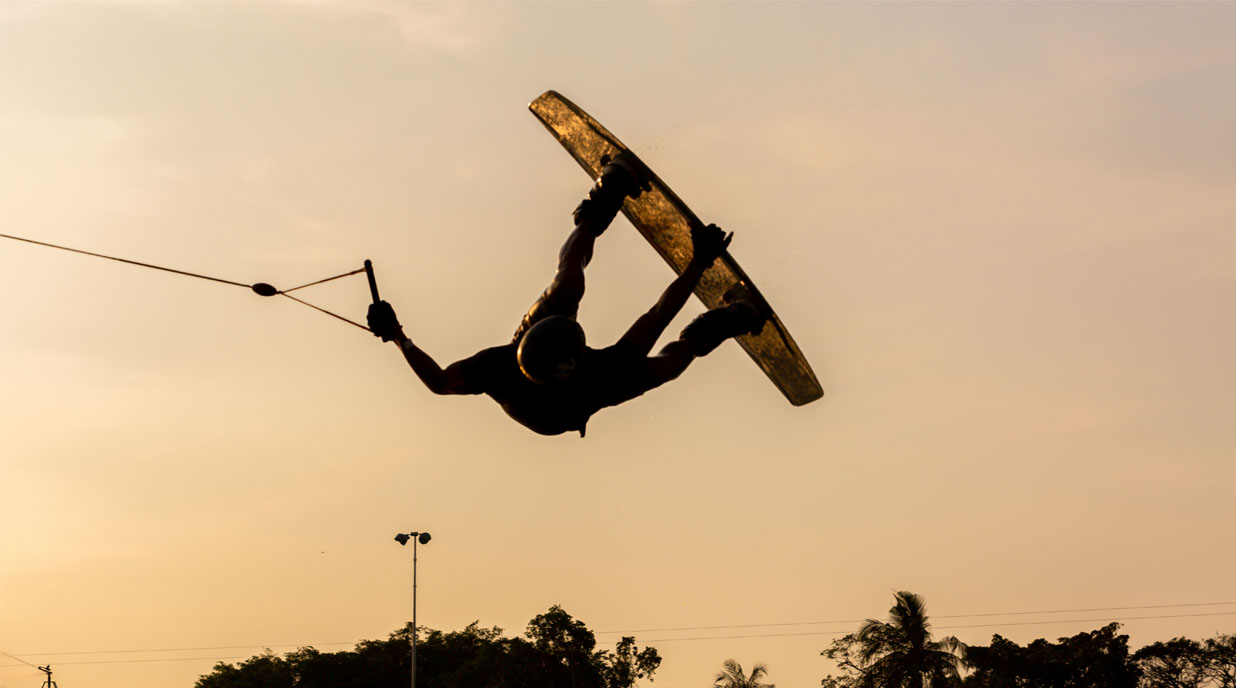
South Corsica, with its spectacular coastline and turquoise waters, is a veritable paradise for water sports enthusiasts. One of the most popular activities is wakeboarding, offering a unique blend of glide, speed and acrobatic tricks.
Whether you’re a beginner looking for your first taste of wakeboarding or an experienced rider looking for a new challenge, knowing where to go wakeboarding is a must. wakeboarding in South Corsica is essential to make the most of your stay.
From sheltered bays ideal for learning to larger bodies of water ideal for freestyle, the region is packed with exceptional spots. This guide reveals the best wakeboarding spots for all levels.
The Advantages of South Corsica for Wakeboarding
An exceptional natural setting
Wakeboarding in South Corsica is first and foremost a breathtakingly beautiful natural setting. Imagine gliding over crystal-clear water, against a backdrop of white sandy beaches, pink granite cliffs and green mountains plunging into the sea.
This unique combination of sea and mountain scenery creates an incomparable atmosphere for water sports. The clarity of the water often allows you to glimpse the seabed as you ride, adding a contemplative dimension to your sporting endeavours.
The diversity of the south Corsican coastline offers a multitude of configurations for wakeboarding. The many protected bays and gulfs, such as those of Santa Giulia, Rondinara and Valinco, offer water conditions that are often calm, especially in the morning, ideal for beginners and those practicing slalom or basic tricks.
Conversely, some more open areas or boat wakes can offer small waves for more experienced riders looking to perform jumps and rotations.
What’s more, the Mediterranean climate guarantees a long wakeboarding season, generally running from April to October. Pleasant summer temperatures and plenty of sunshine make wakeboarding sessions particularly enjoyable.
Even at the beginning or end of the season, with a light neoprene wetsuit, you can take advantage of the excellent excellent conditions offered by Southern Corsica. This wide window of opportunity is a major advantage for enthusiasts wishing to indulge in their favorite sport.
Adapted infrastructures and qualified professionals
In addition to its exceptional natural setting, Corsica du Sud has developed top-quality infrastructures and services to welcome wakeboarders. Numerous watersports centers, specialized schools and independent service providers offer the latest high-performance equipment for hire, as well as courses and workshops for all levels.
This structured offer greatly facilitates access to the activity, whether you’re a local resident or just passing through.
Wakeboarding professionals in South Corsica are generally experienced enthusiasts with the requisite qualifications (BPJEPS water sports activities, aerial gliding or water skiing).
Their in-depth knowledge of local spots, weather conditions and teaching techniques ensures that beginners learn quickly and safely. It also guarantees relevant advice for experienced riders wishing to progress.
It’s worth noting that most schools use boats specifically designed for wakeboarding. These boats are equipped with towing towers, ballasts to create an optimum wave and speed regulation systems (perfect pass). This ensures ideal conditions for practice.
This combination of an exceptional natural environment and a top-quality professional offer makes Corsica the destination of choice for all wakeboarding enthusiasts. Whether you’re looking for a gentle introduction to wakeboarding in a paradise setting, or a challenging playground to push your limits, you’re bound to find the spot and the training to meet your expectations.
The fact is that this accessibility and quality of service contribute greatly to the region’s attractiveness for this fast-growing discipline.
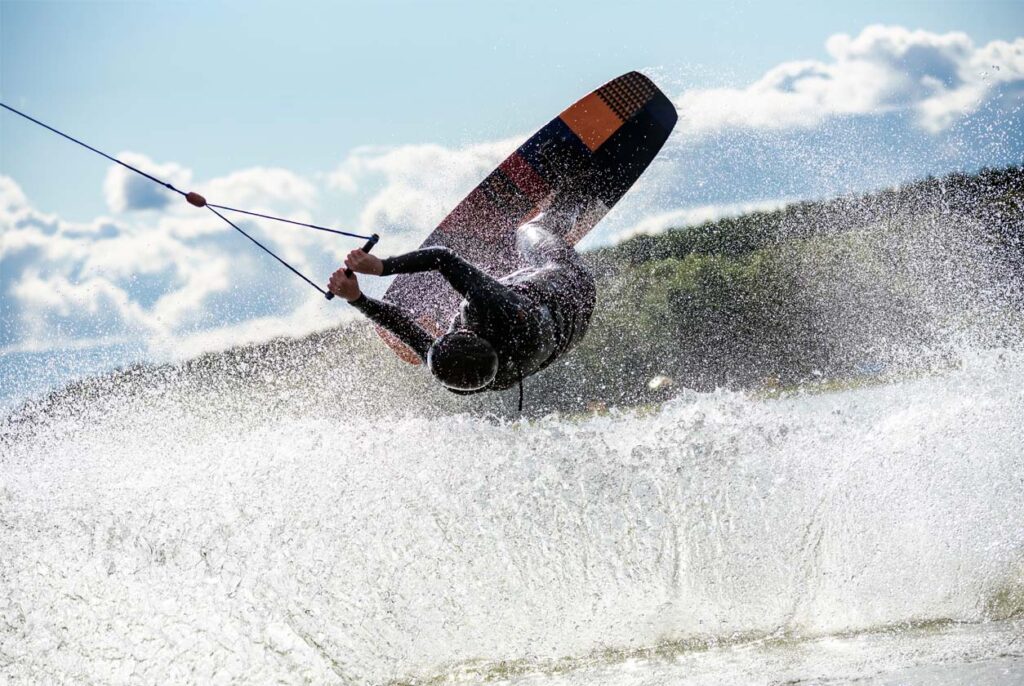
Ideal spots for beginners : Learn with complete peace of mind
Porto-Vecchio’s sheltered bays: Santa Giulia and Palombaggia
The Porto-Vecchio region is particularly renowned for its magnificent beaches, but some of its bays also offer ideal conditions for beginners to wakeboarding. The bays of Santa Giulia and, to a lesser extent, certain areas of Palombaggia, offer very favorable characteristics for beginners.
Their shallow waters over a wide distance and their configuration, generally protected from prevailing winds, create a calm water surface, especially in the morning. This makes it much easier to get off to a good start and learn to glide.
Several sailing schools and bases operate directly from these beaches or in their immediate vicinity. They offer specific introductory packages, often with short sessions (15-20 minutes) for a gentle first approach.
Supervision is generally very educational, with instructors giving personalized advice from the boat using communication systems integrated into the helmets. The shallow depths certain areas even make it easier to get up after a fall without having to swim for long.
It’s important to note that these beaches are very busy in high season (July-August). As a result, wakeboarding sessions are often organized early in the morning (between 8 and 11 a.m.) to benefit from optimal sea conditions and avoid conflicts with bathers and other boats.
This time constraint is more than made up for by the exceptional beauty of the setting. Learning to wakeboard with the sun rising over the turquoise waters of Santa Giulia is a memorable experience.
The Gulf of Valinco: a protected body of water
The Gulf of Valinco, centered around the town of Propriano, is another excellent spot for wakeboarding in Southern Corsica, particularly for beginners and intermediate riders. Its wide bay, well protected from the prevailing westerly winds by the Pointe de Campomoro, offers a generally calm and safe stretch of water, ideal for learning and progressing.
The gulf’s size also makes it easy to find less-frequented areas, even at the height of the season.
A number of water sports providers are based in Propriano or on nearby beaches such as Portigliolo or the Lido. They offer one-to-one lessons or multi-day courses, with equipment suitable for beginners (wide, stable boards, short spreaders).
The local instructors know the specifics of the gulf inside out and know how to choose the best areas according to the day’s conditions. The presence of several small coves along the gulf also makes it possible to organize pleasant swimming breaks during longer sessions.
Beyond the ideal conditions for learning, the setting of the Gulf of Valinco is itself a source of pleasure. Gliding across the water against the backdrop of the Alta Rocca mountains and hilltop villages like Olmeto offer a magnificent visual experience.
This combination of safe water and stunning scenery makes Valinco a wise choice for a first wakeboarding experience in Southern Corsica. What’s more, prices here are sometimes slightly lower than in the touristy spots of the far south.
Playgrounds for Advanced Riders: Expression and Progression
Figari Bay: Wind and Space for Freestyle
For experienced riders looking for a spot offering space and potentially more sustained wind conditions, the bay of Figari represents an interesting option in southern Corsica. Situated between Bonifacio and the Gulf of Valinco, this deep, relatively open bay is more exposed to the winds, particularly the Libeccio (west/south-westerly wind).
When the wind picks up, the water becomes choppier, offering natural kickers for jumps and freestyle tricks.
The size of the bay also makes it possible to sail long distances and find open areas to work on maneuvers without being hindered by other boats. It’s a spot appreciated by local riders for its potential for progression, especially for those who also practice kitesurfing or windsurfing, disciplines for which Figari is also renowned.
It’s worth noting that wakeboarding in windy and choppy conditions requires better technique and balance, making it a stimulating challenge for intermediate and advanced riders.
Few structures offer direct rental or lessons from the Bay of Figari itself, which remains wilder and less equipped than the major tourist gulfs. However, several service providers based in Bonifacio or Porto-Vecchio sometimes organize specific outings to this spot when conditions are optimal.
For independent riders with their own boat and equipment, Figari represents an interesting alternative to the more frequented spots, offering a more rugged setting and potentially more challenging conditions. However, it’s a good idea to be well informed about the weather conditions before venturing out, as the wind can quickly pick up and make navigation difficult.
Le Large de Porto-Vecchio: Vagues de Sillage and Espace Illimité
Off the coast of Porto-Vecchio, once past the coastal zone and sheltered bays, experienced riders can find a huge playground in which to express themselves to the full. The absence of spatial limitations and the possibility of crossing the wake waves of the many passing yachts and boats create opportunities for higher jumps and more complex tricks.
It’s in this environment that wakeboarders looking to push their limits in terms of height and amplitude will find the best conditions.
However, offshore wakeboarding requires specific organization and increased vigilance. It’s essential to have a powerful, suitable boat, piloted by an experienced person familiar with navigation rules and able to manage the rider’s safety (rapid recovery after a fall, monitoring of surrounding marine traffic).
The use of communication equipment (VHF radio) and safety equipment (impact vests, functional circuit breakers) is essential.
Some wakeboard schools in the region offer “advanced coaching” sessions specifically organized offshore for riders wishing to work on technical tricks or prepare for competitions. These supervised sessions offer a safe environment for progression, with personalized advice from the coach and optimal management of the boat’s wave.
The fact is, riding offshore, with the Corsican coast as a backdrop and the sea horizon as far as the eye can see, provides a sensation of freedom and power that is particularly exhilarating for enthusiasts of the discipline. It’s a sporting adventure that demands commitment and respect for maritime rules.
Facilities and Wakeboard Schools
Choosing the right school: Criteria and advice
Your choice ofwakeboard school is crucial to the quality of your experience, whether you’re a beginner or an expert. Several criteria should guide your selection in South Corsica. First of all, make sure the school employs state-certified instructors (BPJEPS in water skiing/wakeboarding or aerotow sports).
This qualification guarantees not only the technical competence of the supervisor, but also his or her training in safety rules and teaching methods.
Then look at the quality of the equipment on offer. Boats must be specifically equipped for wakeboarding (tower, ballast, perfect pass). Boards and boots must be recent, in good condition and available in different sizes to suit all sizes and levels.
A good indicator is the variety of boards on offer: a serious school will have beginner models (wide, stable) and higher-performance models for advanced riders. The provision of compliant safety equipment (vests, helmets if necessary) is also essential.
Finally, find out about the teaching methodology andorganization of the sessions. The best schools prefer small groups or individual lessons for personalized follow-up. The use of coach-rider communication systems (radio headsets) is an undeniable plus for receiving advice in real time.
Read online reviews, but keep a critical eye. Don’t hesitate to contact the school directly to ask specific questions about their approach, practice spots and rates. A school that’s transparent, passionate and focused on the safety and progress of its students is generally a guarantee of quality.
The different formulas: Initiation, Training courses, Coaching
Wakeboard schools in South Corsica generally offer a wide range of formulas to meet the different needs and objectives of wakeboarders.
- Initiation (or baptism): This is the ideal formula for a first discovery. Short in duration (often 15 to 20 minutes of actual riding, preceded by a briefing on land), it allows you to acquire the basics of starting out of the water and the first sensations of gliding. It’s the perfect way to find out if you like the activity before making a bigger commitment.
- One-to-one lessons: lasting from 20 minutes to 1 hour, these offer personalized attention and rapid progress, whether you want to master the basics or work on specific figures. The coach adapts the lesson entirely to your level and objectives.
- Courses: Offered over several days (generally 3 to 5 days), they combine several riding sessions with theory briefings and video debriefings. This is the most effective way to make significant progress, whether you’re a beginner or an experienced rider. They also encourage group spirit and the sharing of experience.
- Advanced coaching: Designed for advanced riders, the aim is to perfect complex tricks (jumps, rotations, grabs, modules if available) with a specialized trainer. These sessions often take place in specific conditions (very calm water or, on the contrary, looking for wake waves).
Prices vary according to formula, duration and period. As a guide, an initiation costs between €40 and €60, an individual lesson between €60 and €100, and a 5-day course between €300 and €500. It’s often more cost-effective to opt for a course or a package of several lessons if you really want to make progress.
Practical advice and safety
Physical Preparation and Recommended Equipment
Despite the fact that wakeboarding is accessible, a minimum of physical preparation is recommended to get the most out of the activity and avoid excessive muscle soreness. A good abdominal and dorsal sheathing helps maintain posture on the board.
A little muscular strengthening of the arms and legs makes it easier to start and hold the rudder. If you’re not particularly athletic, start with short sessions and gradually increase duration and intensity.
As forpersonal equipment, in addition to the equipment provided by the school (board, boots, vest, helmet if necessary), please bring a comfortable swimsuit that doesn’t restrict movement. Anti-UV lycra is highly recommended to protect against the sun and any irritation caused by the vest or rubbing.
Sunglasses with a safety strap are useful to protect eyes from reverberation, although some prefer to ride without them to avoid losing them.
Don’t forget to apply a generous amount of waterproof sun cream before the session, and a hat or cap while waiting on the boat. A towel and a change of clothes are essential after the session.
Finally, remember to stay well hydrated before, during (if possible) and after exercise. Good physical preparation and the right equipment contribute not only to performance, but above all to safety and enjoyment.
Essential Safety Rules and Good Practices
Wakeboarding is fun, but you still need to follow a few essential safety rules to avoid accidents. Listen carefully to the safety briefing given by your instructor before each session. Always wear your lifejacket, properly fitted, even if you’re a good swimmer. Use the circuit breaker attached to your wrist or lifejacket to stop the boat in the event of a fall.
Learn basic communication signs with the boat’s pilot (accelerate, slow down, stop, indicate that all is well after a fall). Never wrap the rudder line around your hands or body. In the event of a fall, immediately release the rudder and signal your position to the pilot by raising one arm out of the water. Wait for the boat to return to you at slow speed before climbing back on board.
Respect the practice zones defined by the school or local regulations. Never sail in marked bathing areas or too close to the shore, rocks orother boats. Be aware of your surroundings and anticipate the trajectories of other users of the sea.
Respecting these simple rules, combined with a responsible attitude, is the key to enjoying the thrills of wakeboarding in complete safety for yourself and others. And don’t forget the rules of courtesy on the water: wait your turn, don’t cut others off, and if necessary, help another rider in difficulty.
FAQ : Wakeboarding in South Corsica, Your Questions
Do I need a boat license to wakeboard in Corsica?
To pilot the towing boat, yes, you need a coastal boating license. To tow the rider, no license is required. If you hire a boat to tow yourself, the pilot must have a license. If you take a course or session with a school, the instructor is the pilot and has the necessary qualifications.
What is the minimum age to start wakeboarding?
The minimum age varies from school to school, but is generally around 7 or 8, provided the child is comfortable in the water and able to understand the safety instructions. Special equipment (smaller boards, adapted spreaders) is used for younger children.
When is the best time to wakeboard in South Corsica?
The season generally runs fromApril to October. June and September often offer the best conditions, with pleasant water, fewer people and sometimes lower prices. July and August are ideal for warm water, but more crowded. Mornings are often the best time to enjoy flat water, ideal for beginners and slalom.
How much does a wakeboarding session in South Corsica cost?
Prices vary, but expect to pay an average of :
- Initiation/Baptism (15-20 min): €40 – €60.
- Individual lesson (20-30 min): 60€ – 100€.
- Free session (if license/autonomous, 1h): May vary, often included in boat rental.
- Course (3 to 5 days): 300€ – 500€
These prices generally include equipment rental and supervision.
Prices for wakeboarding in South Corsica remain affordable, with a range of packages to suit all levels. Investing in these sessions guarantees a supervised, safe and rewarding experience on magnificent waters.
Is wakeboarding a difficult sport to learn?
Wakeboarding is relatively accessible. Most beginners are able to get out of the water and glide a few meters on their first session, especially with the right coaching and equipment. Progress then depends on motivation and frequency of practice. The first tricks (crossing the wake, small jumps) can be learned fairly quickly.
Can you wakeboard if you can’t swim very well?
It’s best if you’re comfortable in the water, but it’s not essential to know how to swim perfectly, as you’ll be wearing a lifejacket to ensure your buoyancy. The most important thing is not to panic in the event of a fall, and to be able to reach the board or wait for the boat calmly. Tell your instructor your swimming level before you start.
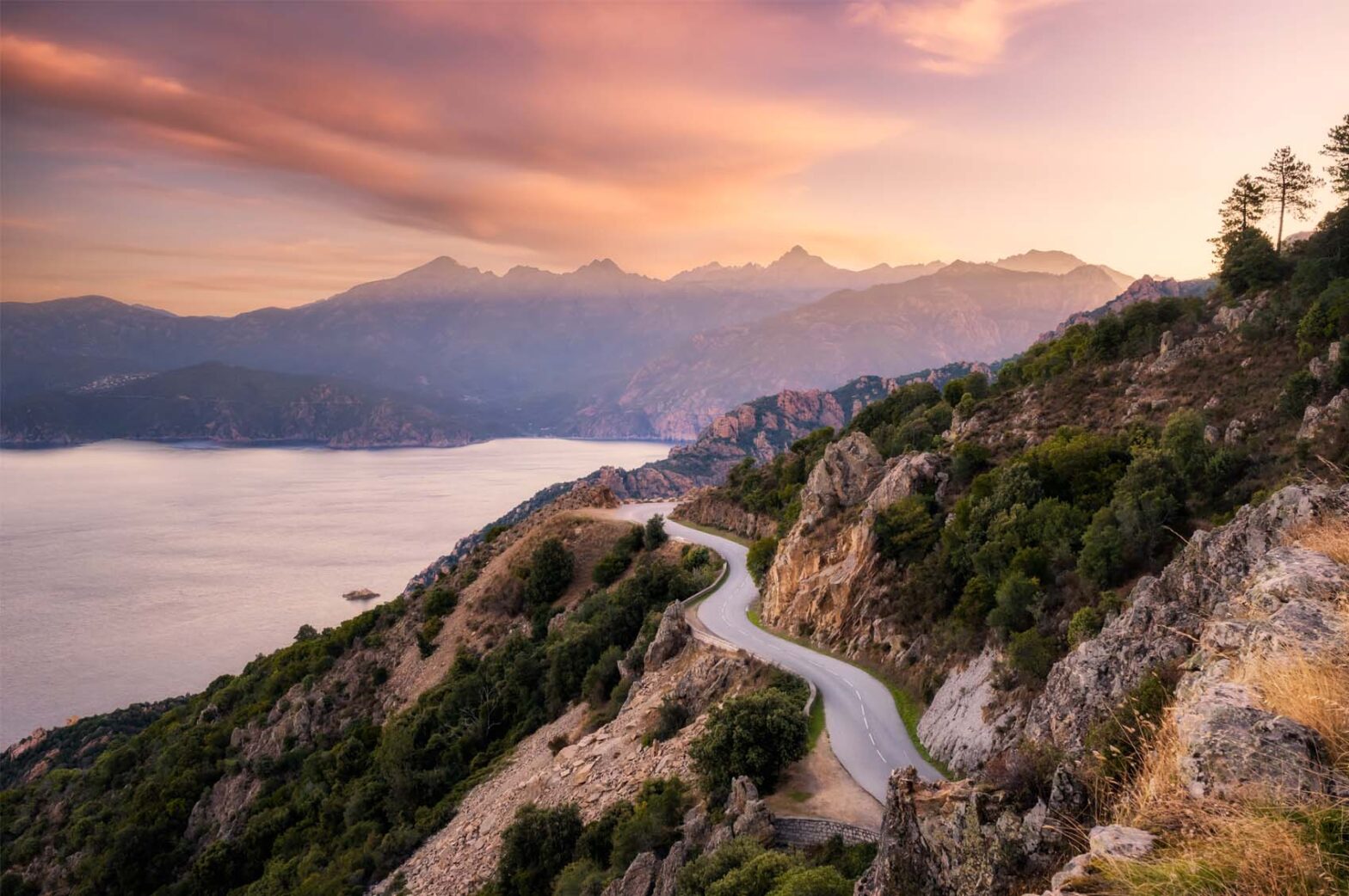
Southern Corsica is a land of exception, an unspoilt sanctuary where nature displays its finest finery. For nature lovers, this territory is a promise of constant wonder, an invitation to explore and contemplate.
Far from being limited to its world-renowned beaches, the region is home to a multitude of unmissable spots where the fauna, flora and grandiose landscapes are revealed in all their splendour.
From breathtaking cliffs plunging into a turquoise sea, to granite peaks guarding ancestral forests, to crystal-clear rivers winding through fragrant scrubland, Southern Corsica offers a rare ecological diversity. This guide takes you on a journey of discovery of the emblematic and secret places that will delight nature lovers.
Le Littoral Préservé: Between Sculpted Cliffs and Turquoise Waters
Bouches de Bonifacio Nature Reserve and the Lavezzi Islands
The Bouches de Bonifacio Nature Reserve is undoubtedly one of the major natural jewels of southern Corsica. Covering 80,000 hectares, it is the largest marine reserve in mainland France, and a veritable sanctuary for Mediterranean biodiversity.
Nature lovers will find it an exceptional place to explore, both from the sea and along the coastal paths. Bonifacio’s limestone cliffs, sculpted by wind and sea spray, offer spectacular vistas and are home to a specific flora adapted to these extreme conditions.
At the heart of this reserve, the archipelago of the Lavezzi Islands represents a unique ecosystem. These rounded granite islands, polished by erosion, create an almost lunar landscape, surrounded by extraordinarily clear waters. Accessible only by boat from Bonifacio, the Lavezzi are a paradise for snorkeling and diving.
Curious groupers, shoals of sars and a multitude of other species are frequently encountered in the midst of posidonia meadows, essential to the ecological balance of the Mediterranean. The marked trails on the main island also offer the chance to discover specific flora and colonies of seabirds such as the grey shearwater.
It’s important to remember that these sites are strictly protected. Navigation, diving and hiking are regulated to preserve their integrity. According to the latest guidelines issued by the Bouches de Bonifacio International Marine Park for the 2024-2025 season, anchorage areas are limited and sailing speed controlled.
Respecting these rules is essential if these unmissable spots preserve their magic and biological richness for future generations. A visit to these places, imbued with respect, offers a lesson in humility in the face of the power and beauty of preserved nature.
Wild Beaches beyond Postcards
While South Corsica is famous for its iconic beaches such as Palombaggia and Santa Giulia, it also boasts many wild beaches and secret coves that will delight nature lovers in search of tranquillity. These unspoilt spots, often accessible after a walk through the scrub or by sea, offer a more authentic and intimate experience of the Corsican coastline.
They are characterized by an almost total absence of tourist facilities, giving way to the raw beauty of the landscape.
Roccapina beach, dominated by its famous lion-shaped rock and Genoese tower, is a perfect example. Accessible by footpath or coastal path, its fine sand and translucent waters make for an impressive setting.
Similarly, the beach at Campomoro, further north in the Gulf of Valinco, captivates with its authenticity and vast expanse of sand bordered by unspoilt scrubland. These well-known beaches retain an appreciable wild character, particularly outside the peak summer season.
For an even deeper immersion, venture out onto the less-frequented paths or explore the coast by paddle or kayak. Coves such as Cala di Conca, accessible after a pleasant hike from Tizzano, or Capo di Feno, close to Bonifacio but facing west, offer havens of peace where nature reigns supreme.
The fact is that discovering these beaches often requires a little effort, but the reward is just as good: the feeling of being alone in the world in front of an incredibly pure sea. Don’t forget to pack everything you need (water, food, sun protection) and, above all, to leave no trace of your visit.
The Secrets of the Rocky Shores by Kayak or Paddle
Exploring the rocky coastline of Southern Corsica in a sea kayak or Stand-Up Paddle (SUP) is a privileged adventure for nature lovers. These silent, eco-friendly craft offer an intimate approach to the coastline, revealing details inaccessible from land or larger boats.
They offer the chance to squeeze through narrow passages, enter shallow sea caves andobserve coastal fauna without disturbing them.
The coastline between Bonifacio and Porto-Vecchio is particularly well-suited to this type of exploration. Cave-pierced limestone cliffs, small inlets and rocky islets such as Cerbicales offer an exceptional playground.
Paddling along Bonifacio’s cliffs provides a unique perspective on this perched citadel, and allows you to discover sea caves such as the famous Sdragonato grotto (accessible depending on sea conditions). The transparency of the water allows you to admire the seabed while sailing.
Further west, the coast around Campomoro and Tizzano has a wilder character, with vast stretches of scrubland plunging into the sea and granite formations sculpted by erosion. It’s an ideal area for kayak trips lasting several hours or even a day, with numerous opportunities to land on isolated beaches for a picnic or swimming break.
It’s interesting to note that sailing close to the water increases the chances of seeing seabirds (crested cormorants, gulls) and sometimes even dolphins playing offshore. dolphins playing offshore. This proximity to the elements and wildlife makes kayaking and paddling the perfect exploration tools for naturalists.
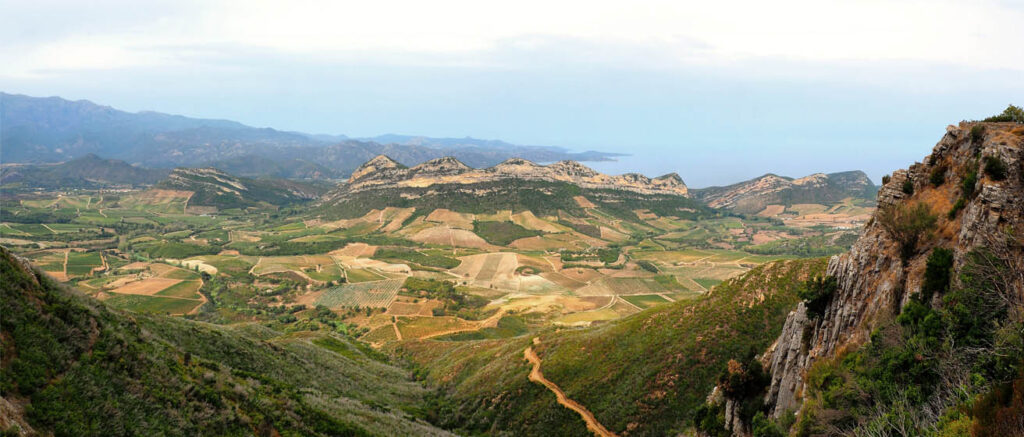
The Call of the Mountains: Grandiose Panoramas and Ancestral Forests
The Massif de Bavella and its Majestic Needles
The Massif de Bavella is undoubtedly one of South Corsica’s must-see spots for nature and mountain lovers. These spectacular needles of pink granite rise proudly above vast forests of laricio pine, creating an alpine landscape unique in the Mediterranean.
Hiking is the best way to explore this grandiose site, with itineraries to suit all levels. The famous “Trou de la Bombe” (U Cumpuleddu), a natural arch offering a window onto the landscape, can be reached by an easy family hike of around 1h30 round trip from the Col de Bavella.
For more experienced walkers, the alpine variants of the GR20 that cross the massif offer technical challenges and breathtaking panoramas. The ascent to the Paliri refuge or the traverse to the Coscione plateau are demanding but unforgettable hikes.
These trails wind their way through scree slopes, along vertiginous cliff faces and offer breathtaking views over the gulfs of Porto-Vecchio and Valinco. The flora is also remarkable, with endemic species adapted to the altitude and granite soils.
In addition to hiking, Bavella is also a mecca for rock-climbers, with hundreds of routes carved into its walls, renowned for the exceptional grip of their rock. Even without practicing these vertical activities, simply contemplating these “Corsican Dolomites” from the pass or the many lookouts along the way is a memorable experience.
The atmosphere changes radically depending on the time of day and the weather, from bright, welcoming landscapes to more austere, mysterious atmospheres when the clouds cling to the peaks.
Forêt de l’Ospédale: lake and Laricio pines
The Ospédale forest, located on the heights overlooking the Gulf of Porto-Vecchio, offers a welcome interlude of coolness and tranquillity. Particularly popular with nature lovers on hot summer days.
This vast state forest is mainly made up of majestic laricio pines, a species endemic to Corsica and recognizable by its slender stature and silvery-grey bark. Walking under the canopy of these hundred-year-old giants, in a silent atmosphere disturbed only by birdsong, is an interesting experience.
Lac de l’Ospédale, an artificial dam harmoniously integrated into the landscape, forms the heart of this forest massif. Its shores offer magnificent views and shaded picnic areas. An easy walk of around an hour takes you partially around the lake, through wooded areas and along the banks.
It’s an ideal family walk, accessible to all and offering great nature-watching opportunities. Cows and wild pigs can be seen watering, adding a picturesque touch to the landscape.
The Ospédale forest is also the starting point for several more ambitious hikes, including the one to the Piscia di Gallu waterfall. This relatively short trail (approx. 2h round trip) has a significant gradient and a more technical finish to reach the foot of this impressive 60-meter waterfall.
The reward is as great as the effort: a grandiose natural spectacle in the heart of unspoilt nature. Whether you’re looking for a simple stroll around the lake or a more challenging hike, the Ospédale forest is a must for lovers of forest nature and landscapes combining water and mountains.
The Coscione Plateau: A Unique Altitude Ecosystem
For total immersion in unspoilt wilderness, the Coscione plateau (U Cuscionu) is the destination of choice for discerning nature lovers. Located in the heart of the Parc Naturel Régional de Corse, between 1500 and 1800 meters above sea level, this vast, high-altitude plateau boasts a unique ecosystem characterized by pozzines.
These thick, spongy grasslands, dotted with waterholes, create an astonishing landscape sometimes reminiscent of Ireland or Iceland, in stark contrast to the Mediterranean scrub at lower altitudes.
Hiking the Coscione is a very special experience. The paths, sometimes barely marked, cross vast expanses of grass where herds of cows, horses and semi-wild pigs graze freely. This large animal presence contributes to the unique atmosphere of the area.
The flora is also unique, adapted to the harsh climatic conditions of altitude, with many endemic species blooming in spring and early summer. The silence and sense of immensity that emanate from this plateau are particularly appreciated by hikers in search of solitude and tranquillity.
Access to Coscione is generally via tracks from the villages of Zicavo or Quenza. We recommend the use of a 4×4 vehicle or a long approach walk. The plateau can then be explored on several hiking trails, such as the loop around the Bassetta sheepfolds or the climb to Monte Incudine (accessible from the plateau).
It should be noted that this site is subject to sometimes extreme weather conditions, even in summer, with risks of sudden fog or violent thunderstorms. sudden fog or violent thunderstorms. Good preparation and the right equipment are therefore essential for exploring this demanding Corsican mountain spot in complete safety.
Les Rivières Cristallines: Oasis of Freshness in the Heart of the Maquis
The Cavu and Solenzara Natural Swimming Pools
South Corsica’s rivers offer refreshing and spectacular alternatives to coastal beaches, particularly popular with nature lovers on hot summer days. Among the most accessible and renowned are the natural pools of Cavu, near Sainte-Lucie de Porto-Vecchio.
The river has carved out a succession of clear emerald pools in the granite, linked by small waterfalls and natural slides. The site is easily accessible and offers several bathing areas suitable for all ages, from wide shallow pools to deeper basins allowing a few jumps (always after carefully checking the depth).
The Solenzara valley, gateway to the Bavella massif from the east coast, is also famous for its magnificent natural pools. Along the road leading up to the Col de Bavella, there are several access points to the river, allowing you to discover exceptional bathing sites in a grandiose setting.
The Purcaraccia pools and those near the Fiumicelli bridge are particularly renowned for the beauty of their waters and the polished rocks that surround them. The water is often invigorating, even in midsummer, offering a striking contrast to the ambient heat.
These river bathing sites have become very popular and can be crowded in high season. Fora more leisurely experience, it’s best to visit early in the morning or late in the afternoon. It’s also possible to find more secluded pools by taking a short walk along the river away from the main access points.
We remind you of the importance of preserving these fragile environments by leaving no trace of your passage and respecting the tranquility of the area. For nature lovers, these unmissable spots offer much more than a simple swim: a deep connection with the aquatic element in an exceptional mineral and plant setting.
The Secret Gorges and Water Hiking
In addition to the natural pools that are easily accessible, South Corsica has many more secret gorges that lend themselves wonderfully to aquatic hiking. This activity, less technical and more challenging than sport canyoning, consists of climbing up or down a river bed, alternating between walking in the water, swimming in the pools and overcoming small natural obstacles (rocks, rapids).
It’s a fun, immersive way to discover wild, unspoilt stretches of river, often inaccessible by traditional paths.
Rivers such as the Taravo, the Rizzanese and some of the lesser-known tributaries of the Solenzara offer magnificent aquatic hiking trails. The equipment required is minimal: good waterproof shoes (trail shoes or used sneakers), a swimsuit and possibly a lightweight shorty for the coldest.
Exploration is generally done upstream, allowing you to choose your passages and easily turn back when you reach your limits or time runs out.
This outdoor activity is particularly suited to families with teenagers or groups of friends looking for a refreshing and original adventure. It allows you to observe aquatic fauna (trout, eels, insect larvae) and riverbank flora at close quarters in an unspoilt environment.
The fact is, progress in water, feeling the currentand overcoming natural obstacles provides a gratifying sense of freedom and adventure. Although less risky than canyoning, aquatic trekking nonetheless calls for caution: beware of slippery rocks, check depth before jumping, and beware of the weather (risk of rapid flooding if there’s a storm upstream).
For a first experience, hiring a local guide can be a good way to discover the most beautiful routes in complete safety.
Le Maquis Parfumé: Sensory and Botanical Immersion
Les Sentiers de l’Arrière-Pays Sartenais
TheSarten hinterland, the historic and cultural heart of southern Corsica, offers nature lovers immersive hikes in the heart of the Corsican maquis. This dense, fragrant plant formation, emblematic of the island, covers the region’s granite hills, creating landscapes of wild, austere beauty.
Hiking the trails that criss-cross this hinterland is a unique sensory experience. Where the scents of immortelle, myrtle, rockrose and rosemary mingle with the warmth of the sun and the song of the cicadas.
Several itineraries allow you to explore this authentic region. The loop around Sartène, “the most Corsican of Corsican towns”, offers a wonderful introduction to the Sarten landscapes, combining discovery of the built heritage with immersion in the surrounding maquis.
Longer routes, such as those linking the villages of Granace, Foza or Santa-Lucia-di-Tallano, follow ancient mule tracks through areas where nature has largely reclaimed its rights. These hikes allow you to appreciate the resilience of Mediterranean vegetation and discover vestiges of the agro-pastoral past (abandoned sheepfolds, cultivated terraces overgrown with scrub).
Hiking in the maquis requires a few precautions. In summer, the heat can be intense and shade scarce. It’s imperative to set off early in the morning, carry plenty of water and protect yourself effectively from the sun. The paths, which are sometimes poorly maintained, can be invaded by thorny vegetation, making it necessary to wear long pants even in hot weather.
However, these minor inconveniences are largely offset by the wild beauty of the landscapes and the unique atmosphere that emanates from these places steeped in history and tradition. A more secret and intimate Corsica is revealed to walkers who dare to venture off the coastal paths.
Discover the Endemic Flora and the Scents of the Maquis
The Corsican maquis is much more than just a landscape; it’s an ecosystem of exceptional botanical richness, particularly fascinating for nature lovers. Hiking in Southern Corsica gives you the opportunity to observe and smell a remarkable endemic flora, adapted to the island’s dry, sunny conditions.
In spring, the maquis explodes with color and fragrance: white or pink rockrose, sea lavender, bright yellow thorny broom, pale blue rosemary and more. It’s an ideal time of year for amateur botanists.
Even in summer, when the vegetation seems drier, the maquis exudes powerful, distinctive scents.Corsican immortelle (Helichrysum italicum), with its small yellow flowers that never fade and its distinctive spicy fragrance, is omnipresent. Myrtle, whose berries are used to make the famous liqueur, gives off a fresh, resinous scent.
Pistachio andarbutus (whose edible fruit ripens in autumn) complete this unique olfactory picture. Strolling through the maquis becomes a true “sensory hiking” experience, where the sense of smell plays as important a role as the sense of sight.
There are a number of options available to visitors for further botanical discovery. Some botanical gardens, such as the Parc de Saleccia in Balagne (accessible from Haute-Corse but relevant to the whole island), present the main species of Corsican maquis and flora in a didactic way.
Themed guided hikes, focusing on plant recognition and their traditional uses (medicinal, culinary), are also offered by specialized mountain guides. These outings not only enable visitors to learn how to identify species, but also to understand the close links that unite Corsican culture to its plant environment.
Wildlife watching: Discretion and Wonder
Encounters with Discreet Terrestrial Fauna
Observing terrestrial fauna in Southern Corsica requires patience and discretion, but encounters can be particularly rewarding for nature lovers. The emblematic animal remains the Corsican mouflon, whose populations are mainly concentrated in the Bavella and Incudine mountain ranges.
Although shy, it’s not uncommon to spot it early in the morning or late in the day, grazing on rocky slopes or moving about in small groups. Using binoculars and choosing a discreet vantage point considerably increases your chances of success.
The Corsican wild boar (U Cignale), smaller and often darker than its continental cousin, is relatively common in scrubland and forests, but its predominantly nocturnal habits make daytime sightings more uncertain. Its tracks (boutis, footprints) are more easily spotted along paths.
The Corsican nuthatch, the only bird endemic to France and found only on the island, can be found in high altitude laricio pine forests. Its characteristic song and the way it flies down the trunks, head downwards, make it recognizable to attentive birdwatchers.
Reptiles are also well represented, including the brightly-colored Tyrrhenian lizard and the discreet Hermann’s tortoise, a protected species that can sometimes be seen slowly crossing a sunny path. It is essential never to disturb these animals and to observe them from a distance, especially Hermann’s tortoise, which is very sensitive to handling.
Respecting the tranquillity of wildlife is the golden rule for all naturalist observers. The best periods for observation are often spring (breeding season) and autumn, when tourist pressure diminishes and the animals are less shy.
The Wealth of Marine Life: Dolphins and Coastal Fish
The South Corsican coastline also offers excellent opportunities for observing marine life. Dolphins are frequently spotted offshore, particularly in the area of the Pelagos sanctuary for marine mammals in the Mediterranean, which covers a large part of Corsican waters.
Several species are present, including the blue and white dolphin and the bottlenose dolphin. Whale watching excursions by boat, departing from Porto-Vecchio or Bonifacio in particular, enable you to get close to these animals while respecting the rules of observation so as not to disturb them. Encounters are random, but always magical.
Even without going far from the shore, coastal fish observation is accessible to all, especially when snorkeling. The rocky areas are home to a wide variety of colorful species: brightly colored peacock wrasse, a variety of crenilabra, striped sars, and sometimes small juvenile groupers in protected areas.
Posidonia meadows, although less spectacular at first glance, are essential nurseries for many species and home to specific fauna such as saupes and starfish.
In fact, even from harbour quays or rocky points, you can often spot schools of mullet or oblades hunting close to the surface. For those with a passion for the sport, the use ofa Mediterranean fish identification guide can greatly enhance the experience.
It’s important to remember that underwater fishing is strictly regulated, and the capture of certain species such as grouper is totally forbidden. Respectful observation remains the best way to appreciate this exceptional marine wealth.
FAQ : Nature in South Corsica, Your Questions
What’s the best time of year to observe nature in South Corsica?
Spring (April-June) is ideal for flora (flowering maquis, wild orchids) and nesting birdwatching.Autumn (September-October) offers beautiful colors, pleasant temperatures for hiking and warm seas for snorkeling.
Summer is perfect for marine life, but the heat can limit land-based activities and wildlife is more discreet. Winter offers migratory birdwatching and peace and quiet, but access to the high mountains is limited.
Do I need a guide to discover these natural spots?
It’s not always compulsory, but strongly recommended for certain sites or activities. For challenging mountain hikes, climbing, canyoning or diving on specific sites, a professional guide brings safety and knowledge of the terrain.
For wildlife observation or botanical discoveries, a naturalist guide can greatly enhance the experience. For well-marked and accessible sites (beaches, easy coastal paths), independent exploration is quite possible with good preparation.
How to observe wildlife without disturbing it?
The golden rule is discretion. Use binoculars to observe from a distance. Stay on trails to avoid trampling habitats. Never feed wild animals. Avoid loud noises and sudden movements.
When at sea, respect the recommended approach distances for cetaceans and never chase animals. When diving or snorkeling, never touch or collect anything. Be particularly vigilant during breeding periods.
Do you need special equipment for these nature discoveries?
Equipment depends on the activity. For hiking: good shoes, water, sun protection, map/GPS. For snorkeling: mask, snorkel, fins (optional). For observation: binoculars, identification guide (birds, flowers, fish).
For supervised activities (canyoning, diving, etc.), specific equipment is generally provided. A camera (possibly waterproof) is always a good idea to immortalize your discoveries.
Are there any useful mobile applications for discovering Corsican nature?
Yes, there are several applications that can enhance your exploration. For hiking: Visorando, Komoot or Iphigénie (IGN maps). For flora identification: PlantNet. For birds: BirdNet (song identification) or Merlin Bird ID. For seabeds: Fishipédia. Remember to download maps or databases offline, as network coverage may be limited in some natural areas.
How can we help preserve these natural sites?
By adopting simple gestures: leave no trace of your passage (bring back all your garbage). Stay on marked trails. Don ‘t pick flowers or collect anything (shells, rocks, etc.). Respect the regulations of protected areas (nature reserves, marine parks, etc.). Avoid making fires. Choose service providers committed to environmental protection.
Support local conservation organizations. Your responsible behavior is essential to preserving the beauty of these unmissable spots.
South Corsica is a magical destination, seducing visitors with its wild beauty and diverse landscapes. It’s an exceptional playground, especially for families in search ofoutdoor activities and unforgettable shared moments.
Far from just dream beaches, this region offers a multitude of opportunities to create shared memories, whether by the sea, along crystal-clear rivers or on accessible mountain trails.
If you’re wondering what to do in South Corsica with your family, this guide is for you. Get ready to discover fun, safe activities for all ages, for an active and happy vacation in the heart of Corsican nature.
Family Maritime Pleasures: Sand, Clear Water and Discovery
Beach Games and Safe Swimming
The beaches of southern Corsica are undoubtedly among the most beautiful in the Mediterranean, and are the ideal playground for families. Stretches of fine sand such as Palombaggia, Santa Giulia or Rondinara offer the perfect conditions for youngsters: shallow waters, generally calm in summer, and sand that’s ideal for castles and various games.
Water temperatures are pleasant from June through to October, enabling long swimming sessions without fear of the cold. It’s worth noting that several of these emblematic beaches have supervised bathing areas in high season, adding an appreciable degree of safety for parents.
Beyond the classic sand games, these beaches are the starting point for many simple and fun outdoor activities. Collecting seashells, spotting small fish near the rocks or trying your hand at bodyboarding on the waves of the seashore are all moments of discovery and sharing.
Remember to equip your children with simple masks and snorkels, even for splashing around on the shore, as the clarity of the water often allows them to spot small crabs or colorful fish, transforming a simple swim into a mini-exploration.
To vary the pleasures, some of the wilder or lesser-known beaches offer a different atmosphere. Campomoro beach, with its golden sand and Genoese tower overlooking the bay, or Roccapina beach, dominated by its famous lion-shaped rock, offer magnificent settings for a family day out.
These sites, often a little less crowded than the stars of the south-east, allow you to enjoy space and nature in a more relaxed atmosphere. Don’t forget youressential equipment : parasol, high-protection sun cream, hats and enough water for the whole family.
Balades Douces en Mer : Kayak and Paddle for the whole Family
Exploring the coastline from the sea is a magical experience, accessible even to families thanks to stable, easy-to-handle craft such as sea kayaks or Stand-Up Paddle (SUP). These outdoor activities allow you to approach the coast at a gentle pace, discover coves inaccessible on foot and observe the landscape from a different angle, all in a silence conducive to contemplation.
The sheltered bays of Valinco, Figari and Santa Manza offer ideal conditions for a family initiation, with generally calm waters, especially in the morning.
The sea kayak, available in double or triple versions, is perfect for a parent/child outing. The adult can manage the main propulsion, while the youngest discover the joys of paddling and observing the landscape.
It’s a great way to cruise along rocky coastlines, explore shallow sea caves or simply find a quiet spot for a swim. The stability of modern kayaks reassures parents, and even children who can’t yet swim (equipped with suitable life jackets) can join in the adventure.
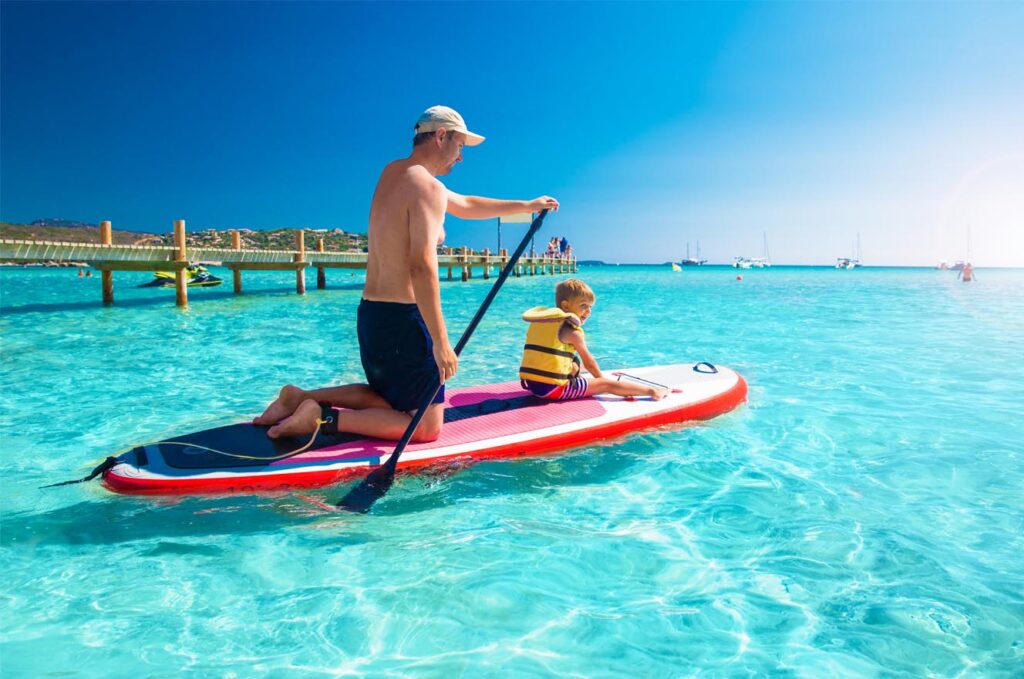
Stand-Up Paddling is becoming increasingly popular with families, thanks to its playfulness and ease of learning on calm water. The wide boards offer good stability, and it’s possible for an adult to paddle with a young child seated at the front. For older children, having their own board (adapted to their size) becomes a fun balancing act.
Incidentally, some rental companies even offer extra-large “family” boards on which several people can stand or sit. Such equipment is widely available for hire on beaches and at water sports centres, often at reduced rates for half or full days.
It’s an outdoor activity that combines gentle physical exercise, coastal discovery and family fun.
Introduction to Snorkeling: Discovering Underwater Treasures
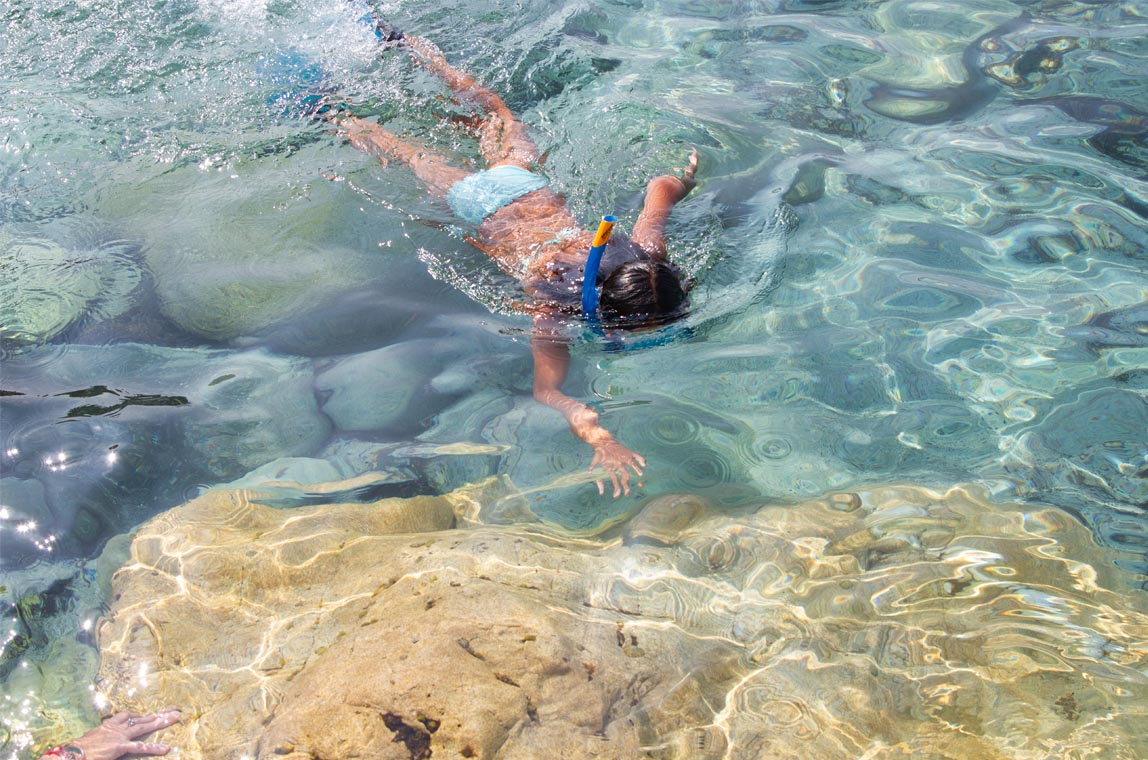
Snorkeling is undoubtedly one of the simplest and most rewarding outdoor activities to enjoy with the whole family in Southern Corsica. The exceptional clarity of the waters makes it easy to observe underwater life, even at shallow depths. It’s a wonderful introduction to Mediterranean biodiversity, accessible as soon as children can swim and are comfortable with a mask.
The best places to start are usually along the rocky areas that line the sandy beaches. These rocks offer shelter and food to a multitude of small, colorful fish (girelles, sars, saupes), starfish, sea urchins and sometimes even small, discreet octopuses.
Beaches such as Rondinara, with its shallow rocky ends, or Cala Rossa, protected and calm, are ideal for a first family exploration. All you need is a well-fitting mask, snorkel and, if necessary, flippers, and you’re ready to float and enjoy the spectacle.
For an even richer experience, some boat trips include snorkeling stops in coves or around islets renowned for their preserved seabed, such as near the Cerbicales Islands or in certain authorized areas around the Lavezzi.
These supervised outings often allow you to observe a greater diversity of species, sometimes with explanations provided by the crew. It’s worth noting that even without sophisticated equipment, simply looking underwater with a mask in these areas reveals a fascinating world that amazes children and adults alike. It’s an inexpensive, easy-to-organize activity that leaves colorful memories for the whole family.
Refreshing River Adventures
Playful swimming in natural pools
When the summer heat is intense on the beaches, the rivers of Southern Corsica offer a refreshing and fun alternative for the whole family. The island’s interior is criss-crossed by crystal-clear watercourses, which over the millennia have carved out gently shaped natural pools surrounded by polished rocks and lush vegetation.
These sites, often accessible after a short walk, offer idyllic bathing spots in fresh, invigorating water.
The Cavu valley, near Sainte-Lucie de Porto-Vecchio, is particularly renowned for its successive emerald pools, easily accessible and family-friendly. Shallow areas allow younger children to splash about in complete safety, while older children can try their hand at jumping off the rocks (always checking the depth beforehand).
The Solenzara, with its large natural pools near the Col de Bavella, and the Fiumicelli also offer magnificent river bathing opportunities in spectacular settings.
These days at the river are often synonymous with picnics in the shade of pines or alders, building small dams with pebbles and relaxing to the soothing sound of flowing water. It’s a simple, free outdoor activity that lets you discover another facet of Corsica, a more secretive and mountainous one.
Be aware, however, that some well-known sites can be very crowded at the height of summer, so don’t hesitate to ask the locals or your accommodation provider for advice on finding quieter spots. You should also keep an eye on the weather, as storms in the mountains can cause flash floods.
Easy descents in Canoe-Kayak
For a more dynamic way of discovering rivers, canoeing and kayaking on the calm stretches of certain watercourses is a fun, family-friendly outdoor activity. Unlike canyoning, canoeing takes place on wide, shallow stretches of river, with no major rapids, allowing you to cruise along at a leisurely pace.
Several rivers in southern Corsica, such as the Taravo and the Rizzanese in their lower reaches, offer courses suitable for family initiation.
Settled into stable canoes (2-3 seats) or easy-to-maneuver sit-on-top kayaks, you’ll cruise down the river at your own pace, enjoying the scenery and stopping for swimming breaks on the small pebble beaches that line the river.
It’s an excellent way to observe the flora and fauna of the riverbanks (dragonflies, birds, freshwater turtles like the cistude) in almost total silence, disturbed only by the sound of the paddles.
A number of leisure centers located along these rivers offer equipment rental and run organization, with a shuttle service to take you back to the starting point. These “turnkey” packages greatly simplify logistics.
The courses on offer generally last between 1h30 and 3 hours, a duration well suited to the abilities of children (often aged 6-7 and over). The fact is that this activity combines moderate physical effort, the discovery of landscapes different from those of the coast and the refreshing pleasure of white water, making it a very complete and popular family outing.
Family-friendly land exploration
Easy hikes on marked trails
Hiking is a must-do activity in Southern Corsica, and many routes are perfectly suited to families with children. Far from the demanding paths of the GR20, these easy routes offer a great introduction to Corsican landscapes without requiring exceptional physical condition.
The aim is to share a pleasant moment in the heart of nature, with the emphasis on discovery and fun rather than sporting performance. Coastal paths, often relatively flat, are an excellent option.
The coastal path between Campomoro and Tizzano, for example, offers a flexible hike along a wild, unspoilt coastline. You can choose to hike just a short stretch to a secluded cove for a picnic and a swim, or continue for several kilometers, depending on the age and motivation of your children.
Similarly, the Bruzzi trail, near Pianottoli-Caldarello, offers an easy 1.5-hour loop through a landscape of wind-sculpted granite rocks and low maquis vegetation, with superb sea views.
Inland, theOspédale forest also offers shady, accessible trails, such as the walk to the “Trou de la Bombe” (U Cumpuleddu), an impressive geological curiosity. This easy 1h30 round trip hike is punctuated by views of the coastline and offers a pleasant immersion in a forest of laricio pines.
To motivate the younger ones, consider incorporating fun elements into the hike: a nature treasure hunt,insect observation, tree recognition or the construction of ephemeral huts during breaks. It’s a good idea to choose itineraries with a loop or a clear objective (a waterfall, a viewpoint, a sheepfold) to keep children’s interest.
Adventure park and tree climbing in the forest
For a controlled dose ofadrenalin and a fun outdoor activity that generally appeals to all ages, high adventure courses (accrobranche) are an excellent option in South Corsica.
Set in pine or oak forests, these parks offer a range of itineraries adapted to the abilities and size of participants, from “pitchoun” courses for toddlers (aged 3 and over) to black courses for teenagers and adults in search of thrills.
These courses consist of a succession of workshops suspended between trees: monkey bridges, climbing nets, balance beams, Tarzan jumps and, of course, the inevitable zip lines. Progress is made in complete safety, thanks to special equipment (harness, lanyards, karabiners) and often a continuous lifeline to prevent accidental detachment.
It’s an ideal activity for developing children’s agility, self-confidence and sense of balance, while having fun in the great outdoors.
There are several high-quality adventure parks in southern Corsica, notably in the Porto-Vecchio region (Ospédale park), near Propriano or in the Taravo valley. Most offer picnic areas and sometimes other complementary activities (paintball, inflatables, etc.).
Allow 2 to 3 hours to fully enjoy the trails. It’s a perfect half-day outing for the whole family, offering a good compromise between physical challenge, fun and contact with Corsican forest nature.
Animal Encounters and Educational Discoveries
Donkey Rides: A Gentle Approach to the Maquis
For an original outdoor activity that’s particularly popular with young children, donkey rides offer a gentle, authentic way to discover the countryside. They allow you to explore the Corsican maquis in a natural and peaceful setting.
A number of farms and specialized facilities in southern Corsica offer guided walks on easy trails. Children (generally aged 3 and over) can ride on the backs of these gentle, patient animals, while parents walk alongside.
These walks, lasting from 30 minutes to 2 hours, offer a slow, sensory immersion in nature. At the donkey’s leisurely pace, you take time to observe the details of the flora, listen to the sounds of the scrubland and enjoy the landscape effortlessly.
It’s also an opportunity for children to establish a privileged contact with the animal, brush it before setting off and learn how to guide it (under supervision). Corsican donkeys are small and perfectly adapted to the local terrain, and are renowned for their docile nature.
These structures often offer packages combining the walk with a visit to the farm, the discovery of other animals or a tasting of local produce. This transforms a simple walk into a more complete educational experience of rural Corsica.
It’s an ideal activity for families with young children who can’t yet follow long hikes. It allows them to take part in an exploration of nature adapted to their age and abilities.
In Cupulatta: The Turtle Village
Located near Ajaccio, A Cupulatta (“the turtle” in Corsican) is a park unique in Europe, entirely dedicated to the breeding and protection of land and water turtles from all over the world. This visit is a fun and educational outdoor activity, fascinating for children and adults alike.
The park is home to over 170 species and subspecies of turtle, representing some 3,000 individuals, in enclosures designed to replicate their natural habitat as closely as possible.
A visit to the park, which takes around 2 hours, reveals an incredible diversity of shapes, sizes and colors : from giant Seychelles and Galapagos tortoises to tiny Hermann’s tortoises, endemic to Corsica.
Clear explanatory panels and regular animations (feeding, presentation of the residents by the caretakers) make the visit lively and instructive. You’ll learn a great deal about the biology of these fascinating animals, the threats they face and the conservation actions undertaken by the park.
Beyond the purely animal aspect, A Cupulatta is a pleasant place for a family walk. The shady paths, water features and lush vegetation create a peaceful atmosphere. There’s even a nursery where you can observe baby turtles just after they hatch, a particularly moving moment.
The fact is, this visit is an excellent opportunity to raise children’s awareness of the need to protect biodiversity and respect the animal world, while at the same time having a pleasant and entertaining time. It’s an ideal half-day outing, easily combined with other discoveries in the Ajaccio region.
Tips for Successful Family Activities
Adapting activities to individual ages and desires
The key to successful outdoor activities for the whole family lies in choosing experiences adapted to the age, abilities and desires of each member. In Southern Corsica, the diversity of the offer allows this adaptation, but it requires careful planning.
For families with very young children (under 5), opt for short activities close to your accommodation, offering frequent rest periods. Beaches with shallow waters, donkey rides or stroller trails in the forest are ideal options.
With children of school age (6-12), the range of possibilities is considerably wider. This is the ideal age for sports activities (snorkeling, kayaking, paddle boarding, easy tree-climbing),fun hikes with a clear objective (waterfall, viewpoint) or educational tours like A Cupulatta.
Involve them in the choice of activities to boost their motivation. Don’t hesitate to incorporate a “game” or “challenge” dimension, such as a nature treasure hunt during a hike or a sandcastle contest, to keep their interest.
For teenagers, the challenge is often to find sufficiently stimulating activities, while preserving moments of family togetherness. Sensational sports such as jet skiing, towed buoys, canyoning and via ferrata are generally very popular.
You should also allow them moments of autonomy, for example, by allowing them to explore a part of the campsite or a supervised beach with their friends, while defining clear rules. The key is to strike a balance that satisfies teens’ need for independence while encouraging shared experiences.
Safety and preparation: the essentials
Safety is the top priority when it comes to any family outdoor activity in South Corsica. A few basic rules apply, whatever the age of the participants. Sun protection is crucial: factor 50+ cream, wide-brimmed hats, sunglasses and, ideally, anti-UV clothing for prolonged aquatic activities.
Hydration is also essential, especially in summer: always provide more water than you need, and encourage children to drink regularly, even if they don’t feel thirsty.
Equipment must be adapted to the activity and the child’s morphology. For hiking, closed shoes with a good sole are essential. For water sports, make sure that the life jackets supplied are the right size and fit properly.
For snorkeling, a well-fitted mask avoids the unpleasant water ingress that can discourage the youngest. Don’t hesitate to invest in quality equipment for children, as comfort is a key factor in their enjoyment.
Finally, always adapt the pace and duration of the activity to the abilities of the youngest or least trained participant. Plan regular breaks and energy snacks, and be alert to signs of fatigue or discomfort.
It’s better to shorten an outing or give up on an ambitious goal than to turn a day of fun into an exhausting ordeal. Flexibility and attentiveness are the key words for successful and serene family adventures.
FAQ : Family activities in South Corsica
Which beaches in southern Corsica are best for young children?
The beaches of Palombaggia, Santa Giulia, Rondinara and Pinarello are particularly recommended for their shallow waters, fine sand and gentle currents. They often have supervised areas in summer and services (parasol rental, snack bars). The beach at Campomoro in Valinco is also an excellent, well-protected option for families.
How easy is it to hike with a stroller?
Some very easy hikes are available, but these are still rare. The Tombolo trail around the Etang de Biguglia (near Bastia, but accessible) is partly accessible. Some stretches of coastal paths on the east coast may be suitable. Inland, you’ll be better off with a backpack, which is much better suited to Corsican terrain, even on “easy” trails.
Are there water sports activities specifically for toddlers (under 5)?
Options are more limited, but they do exist. Glass-bottomed boat trips are often popular. Some water sports centers offer “sea gardens” with adapted water games in pools or highly protected areas. Tandem paddling with an adult on a wide, stable board is possible on very calm water. The priority remains the child’s safety and comfort (adapted lifejacket, maximum sun protection).
Should family activities be booked well in advance?
For very popular activities with limited capacity (certain boat excursions, family canyoning, accrobranche in high season), it’s best to book a few days in advance. For simple rentals (kayak, paddle) or less structured activities (hiking, beach), booking the day before or the same day is often possible, but anticipation guarantees availability.
What’s the budget for family activities?
Budgets vary widely. Beach days or self-guided hikes are free. A snorkeling trip costs the price of equipment rental (around €10-15/person). A kayak or paddle trip costs €40-60 for a half-day family outing.
A canyoning or accrobranche outing costs around €40-50 per person. A boat trip costs between €30 and €60 per adult (often at a reduced rate for children). Allow an average budget of €100 to €150 per day for structured activities for a family of 4.
How do you motivate children to go hiking?
Choose age-appropriate routes with clear, fun objectives (waterfall, viewpoint, sheepfold, beach, etc.). Include games (looking for nature clues, recognizing plants, building cairns). Plan frequent breaks with snacks. Tell stories about the places you’ve visited.
Praise their efforts and value their discoveries. Involve them in choosing the route or picnic site. The key is to make the experience fun, not a forced walk.
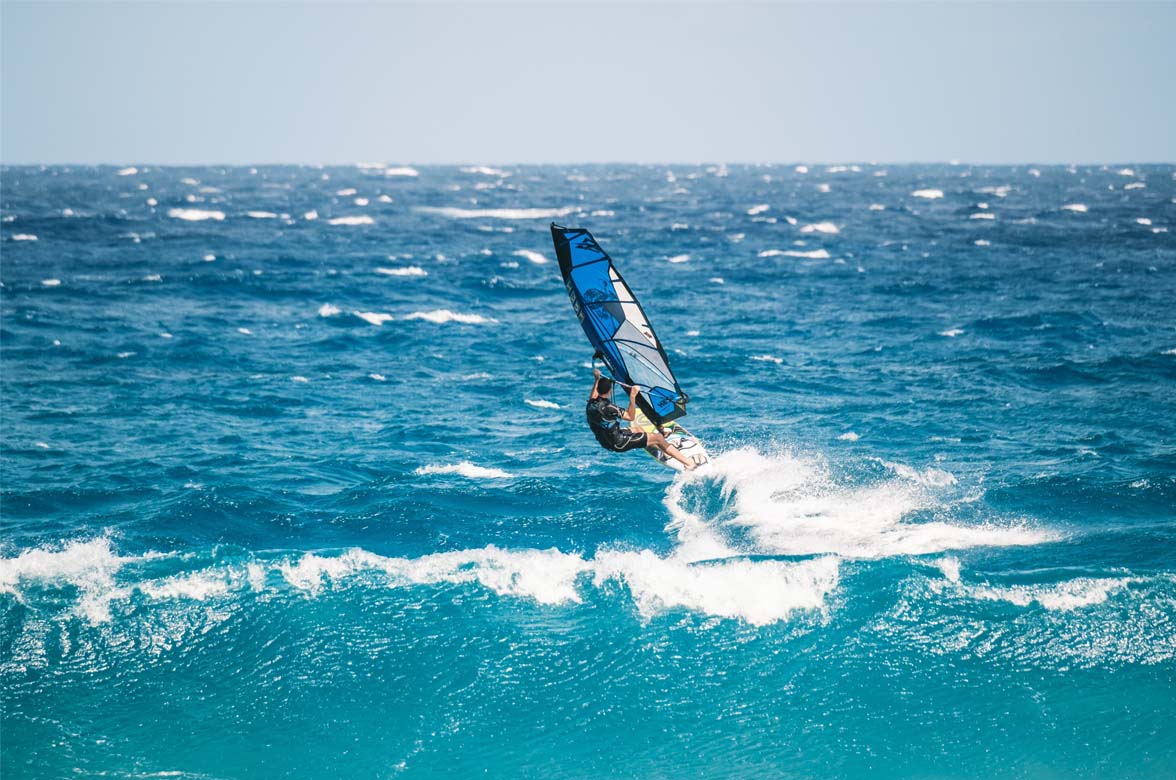
Southern Corsica is not just a destination of idyllic beaches and picture-postcard landscapes. For adventurous souls and thrill-seekers, this exceptional territory is transformed into a huge playground whereadrenalin is king.
From the depths of the sea to granite peaks, tumultuous rivers and coastal winds, the Isle of Beauty offers a unique concentration of activities to push your limits and live intense experiences.
If you’re looking for a vacation in Southern Corsica that’s full of excitement, challenges and thrills, you’ve come to the right place. Get ready to discover a wilder, more exhilarating side of Corsica, far from the beaten track.
Extreme Aquatic Challenges: When the Sea Becomes Your Adventure Terrain
Canyoning Sportif: The Call of the Wild Gorges
Canyoning in Southern Corsica takes on a whole new dimension when you tackle the most challenging and challenging courses. Forget family-friendly descents; here, it’s all about dizzying abseils along powerful waterfalls, technical jumps in deep basins and white-water swimming in narrow, isolated gorges.
The Bavella and Ospédale massifs abound with these itineraries, reserved for experienced climbers or highly motivated beginners in excellent physical condition. Canyons such as the Vacca, the Purcaraccia (with its mythical but demanding slides) or the Piscia di Gallu (with its impressive final abseil) offer 100% adrenaline challenges in natural settings of spectacular raw beauty.
The physical and mental commitment required for these descents is considerable. You need to know how to manage your progress in varied watery terrain, master rope techniques and demonstrate composure in the face of obstacles. The rewards are well worth the effort: the satisfaction of overcoming technical passages, the discovery of otherwise inaccessible landscapes and a feeling of intense communion with Corsica’s wilderness.
The unpredictability of the white water, the play of light in the deep gorges and the isolation of these places create a unique atmosphere, conducive to surpassing oneself.
It’s absolutely essential to practice these sport canyons with professional, state-certified guides. Their expertise is essential to guarantee safety, assess hydrological conditions (which can change rapidly), choose the right equipment and teach you the necessary techniques.
Several specialized structures in southern Corsica offer “expert” or “adventure” outings for the more adventurous. Expect a full day of intense effort, but also unforgettable moments in the heart of the Corsican mountains.
Committed Diving : Mysteries of the Deep and Wrecks
Foradrenalin-seeking scuba diving enthusiasts, Southern Corsica offers much more than simple reef exploration. Deep dives along vertiginous drop-offs or the exploration ofwrecks steeped in history are particularly exciting underwater adventures.
The region’s clear waters often reveal spectacular landforms that fade into the intense blue of the depths, creating a sensation of flight and immensity that can be dizzying.
The sites around the Lavezzi Islands or the southern tip of Corsica are renowned for their drop-offs rich in red gorgonians and pelagic fauna (dentis, barracudas, amberjacks). Diving on these sites, which are sometimes subject to moderate currents, requires good technical mastery and rigorous planning.
Exploring shipwrecks, such as the Cimentier near Porto-Vecchio or other lesser-known relics, adds a historical and mysterious dimension to the adventure. These submerged structures become artificial reefs attracting abundant marine life, but their exploration requires specific skills in wreck penetration and risk management.
Some dive centers offer advanced training courses (confirmed Nitrox, Trimix, deep diving) for those wishing to push their limits in complete safety. The fact is, these committed dives offer unique perspectives on Corsica’s underwater heritage, revealing landscapes and atmospheres inaccessible to less experienced divers.
The planning of these dives must take decompression stops into account, and requires reliable, redundant equipment. It’s a sporting adventure that combines technical challenge, concentration and wonder at the hidden beauty of the Mediterranean depths.
Kitesurfing and Windsurfing: Tame the Corsican Wind
When the wind picks up on the coast of Southern Corsica, kitesurfers and windsurfers find an exceptional playground for 100% adrenaline-filled sessions. Renowned spots such as Sant Amanza or Piantarella near Bonifacio, or La Tonnara, offer often sustained wind conditions, ideal for speed, jumps and freestyle tricks.
Feeling the power of the wind inflate your kite or sail, gliding at high speed over turquoise water and soaring above the waves gives you incomparable sensations of freedom and power.
Kitesurfing, with its manoeuvrable kite, offers spectacular jumps and a wide variety of tricks for experienced riders. The shallow lagoon of Piantarella is an ideal spot for safe training, while Sant’Amanza offers a choppier stretch of water, ideal for freestyle and speed edging.
Windsurfing, on the other hand, is all about the sensation of pure glide and direct connection with the wind. Modern boards enable impressive speeds and radical maneuvers such as jibing and fast tacking.
These disciplines require considerable technical training and a good knowledge of local wind conditions. Several specialized schools offer advanced courses for those wishing to progress to freestyle or waveriding.
South Corsica sometimes hosts national and international competitions, a testament to the quality of its spots. For enthusiasts, tackling an established gale in such a magnificent setting is an intense sporting adventure, where technical mastery mingles with humility in the face of the power of the elements.
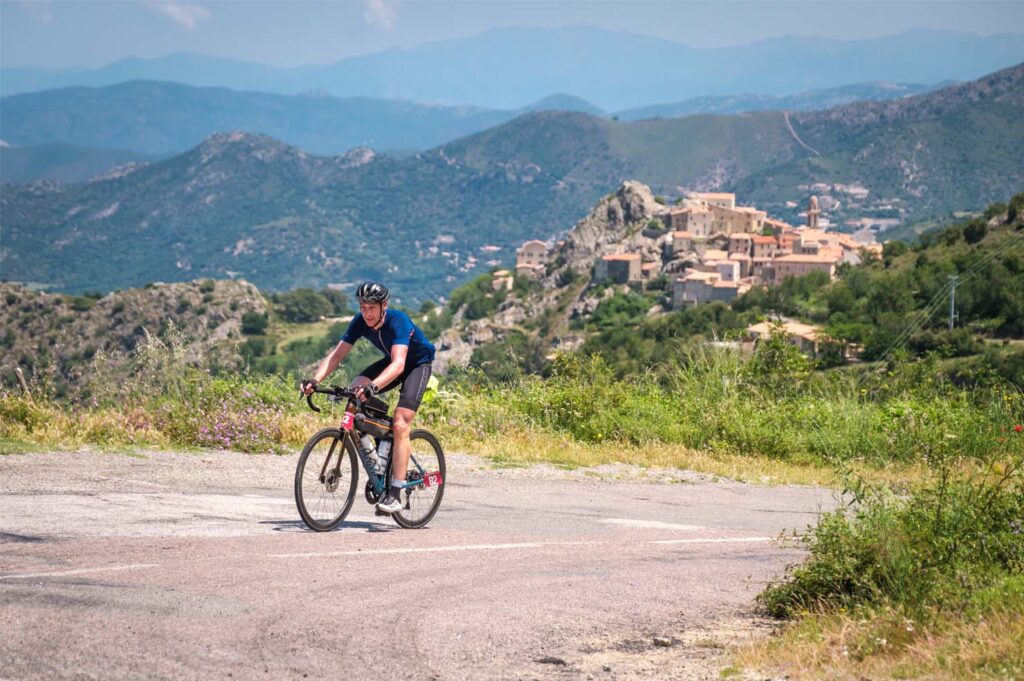
Motorized Adrenalin: Speed and Rapid Exploration
Powerful Freestyle Jet Ski
Jet skiing in South Corsica can be much more than just a leisurely stroll, it can be a real sporting adventure focused on speed and control. Renting powerful machines (often in excess of 150 HP) allows experienced pilots (who hold the appropriate license) to enjoy lightning acceleration and exhilarating speed peaks on authorized waterways.
The feeling of being in control of a machine capable of “flying” at water’s edge is a dose of pureadrenalin.
Beyond straight-line speed, some seek the thrills of freestyle. Even if dedicated areas are rare and regulated, the maneuverability of modern jet skis means that seasoned pilots can make tight turns, “slides” or small jumps on the wake of boats (respecting safety distances).
This requires excellent control of the machine and a perfect understanding of its reactions.
For those who want to combine speed and exploration, long-distance jet ski raids are sometimes organized by specialized service providers. These outings, which can cover 50 to 100 km in a day, allow you to discover a wide variety of coastal landscapes at a steady pace, alternating fast offshore sailing with slower passages close to the coast to admire the remarkable sites.
This endurance on the water, combined with the concentration required to pilot at high speed in sometimes changing conditions, makes for a real sporting challenge.
Flyboard and E-foil: The New Water Toys
For a futuristic dose ofadrenalin, new disciplines such as flyboarding ande-foil are beginning to make their appearance on the coast of southern Corsica. Flyboarding, powered by the water jet of a jet ski to which it is connected by a long hose, lets you literally fly over the water, perform acrobatic tricks and even dive like a dolphin.
Learning to do so requires a certain amount of balance, but the sensation of defying gravity is unique and provides intense excitement. Several watersports centers offer introductory sessions supervised by instructors.
E-foil, or electric surfing on a foil, is another innovation that appeals to fans of new sensations. Mounted on a board equipped with an underwater mast (the foil) and an electric motor, you glide silently over the water once you’ve built up enough speed.
The sensation of flying just a few centimetres above the surface, without noise or apparent effort, is magical and quite addictive. Learning also requires balance and coordination, but provides immense satisfaction from the very first successful “flights”.
These activities are generally more expensive than a simple paddle rental, but offer 100% adrenaline-pumping experiences that are radically different from traditional water sports. They represent the vanguard of water-based leisure activities, and allow you to experience exceptional moments in Corsica’s magnificent setting.
The fact is, mastering these new contraptions is in itself a stimulating sporting challenge, even before you can consider more complex figures.
Vertical Adventures: Climbing, Jumping, Flying
Committed Grandes Voies and Via Ferrata climbing
Climbing in southern Corsica, particularly in the Bavella massif, takes on a major adventure dimension when you tackle the long, multi-pitch routes. Climbing these impressive granite walls, sometimes several hundred meters long, demands endurance, technique and mental commitment.
The airy atmosphere, exceptional rock quality and breathtaking panoramas make climbing at Bavella an unforgettable experience for experienced climbers. Mythical routes such as “Le Dos de l’Éléphant” and routes on the various Bavella towers offer a variety of technical challenges in a wild, unspoilt setting.
For those looking for verticality without the technical expertise of lead climbing, the more challenging via ferrata routes are an excellent alternative. While the Chisa route offers a good introduction, other more recent or lesser-known itineraries feature more athletic sections, longer monkey bridges and overhanging passages that provide a real dose ofadrenalin.
The Tollevone via ferrata, for example, is renowned for its aerial character and some physically demanding sections.
It goes without saying that these vertical practices require specific equipment and a thorough knowledge of safety techniques. For major climbing routes, the services of a mountain guide are indispensable, unless you have solid experience and complete autonomy in adventure terrain.
For difficult via ferrata climbs, even if technically feasible on their own for experienced climbers, it is advisable to be accompanied by a professional to ensure optimum safety and benefit from invaluable technical advice. This confrontation with the void and raw rock is a source of strong emotions and personal achievement.
Paragliding : Acrobatic or cross-country flight
Paragliding in Southern Corsica can also be transformed into an intense sporting adventure for experienced pilots or those seeking sensations beyond a simple contemplative experience. The island’s aerological conditions, in particular the thermal breezes and dynamic updrafts along the relief, make it possible to envisage cross-country flights or even initiations to acrobatics.
Cross-country flying involves using updrafts to cover several kilometers, moving from one relief to another while optimizing your trajectory. This sport requires an excellent knowledge of the aerology, fine piloting skills and a good flight strategy.
Flying over the Bavella peaks or along the coast for dozens of kilometers gives a unique feeling of freedom and accomplishment. Some sites, such as Zonza, are particularly well known for their cross-country flying potential.
For the more daring, anintroduction to paraglidingaerobatics offers guaranteedadrenaline rushes. Supervised by specialized instructors and above the water for added safety, you’ll learn to perform basic tricks such as wing-overs, 360s and SATs.
This discipline demands excellent technical mastery and good physical and mental stamina, but the sensations provided are incomparable. It’s essential to stress that these advanced paragliding techniques are reserved for autonomous, experienced pilots, or take place as part of specific courses with qualified instructors.
Giant zip lines and acrobatic adventure courses
For a dose ofadrenalin accessible to a wider public, high adventure courses and giant zip lines offer thrills in a safe setting. A number of such parks have sprung up in southern Corsica, often set in pine forests or over rivers.
These courses combine various acrobatic workshops: monkey bridges, nets, Tarzan jumps and, of course, long zip lines that provide an impressive sensation of speed and flight.
The Solenzara adventure park, for example, offers several courses of increasing difficulty, some of which reach heights of over 20 metres. The final zip line across the river is a particularly popular highlight. In theOspédale massif, another renowned park offers a variety of workshops in a magnificent laricio pine forest, with zip lines offering panoramic views over the Gulf of Porto-Vecchio.
These activities, although supervised and secured by continuous lifelines or intelligent karabiner systems, generate a realadrenalin rush, especially for people prone to vertigo. Overcoming high obstacles requires concentration, balance and a certain amount of self-transcendence.
It’s a great way to test your limits in a controlled environment, and an ideal ideal activity to share with family or friends for fun and stimulating challenges. Courses generally last between 2 and 3 hours, offering a complete and memorable adventure.
Intense Terrestrial Exploration: Mountain Biking and Trail Running
Enduro and DH mountain biking: mastering the Corsican slopes
Mountain biking in Southern Corsica takes on an intensesporting adventure dimension when you take on Enduro or Downhill (DH) courses. These disciplines require an excellent level of technique, good physical condition and specific equipment (wide-travel full-suspension mountain bikes, full protection).
The inland mountains, notably theOspedale and Bavella massifs, offer an exceptional playground, with technical natural trails, groomed trails and significant vertical drops.
Enduro riding consists of linking often physical climbs with timed special stages (technical descents). Southern Corsica, with its ancient mule tracks and rehabilitated shepherd’s paths, offers many varied Enduro itineraries, alternating fast forest passages, rocky sections and tight hairpins.
Effort management and terrain awareness are essential to performance and enjoyment in this all-round discipline.
Downhill (DH), on the other hand, focuses on the pure pleasure of downhill riding. Thanks to shuttle systems (lifts in 4×4 vehicles), riders can link together several technical descents during the day without the effort of climbing. The trails in the Ospédale forest and some of the wilder Bavella runs offer stimulating challenges with jumps, banked turns and rocky slabs.
This search for the perfect trajectory and maximum speed provides a dose ofadrenalin reserved for experienced, well-equipped pilots. A number of local organizations offer driving courses or guided days with shuttles, enabling you to discover the best spots in complete safety.
Trail Running: defying mountain gradients
Trail running, or running in a natural environment, finds in Southern Corsica an exceptional field of expression for runners in search of challenges and grandiose landscapes. Running along the steep paths of the GR20, tackling the steep gradients of theIncudine or Bavella massifs, or traversing ridges with sea views represents a demanding but deeply rewarding sporting adventure.
The technical nature of Corsican trails, often rocky and steep, demands agility, concentration and excellent physical preparation.
Several renowned trail races are organized every year in Southern Corsica, attracting international-level runners but also offering shorter formats accessible to enlightened amateurs. Highlights include theUltra Trail di Corsica and the Trail de Bonifacio.
Away from the competitions, there are numerous marked routes for training and discovering the region at your own pace. Coastal routes such as the “sentier des douaniers” offer less technical but equally beautiful options, ideal for longer outings or endurance training.
Trail running in Southern Corsica requires good management of effort, hydration and nutrition, especially in summer when the heat can be overwhelming. It’s essential to set off early in the morning, take enough water with you and protect yourself effectively from the sun.
The use of a GPS watch with route tracking is highly recommended, as markings can sometimes be random on less-frequented trails. This discipline allows you to explore the territory quickly and lightly, offering a unique feeling of freedom and an intense connection with Corsica’s wilderness.
Preparation and Safety: The Keys to a Successful Adventure
Choosing Qualified and Insured Service Providers
Safety is paramount when it comes toadrenaline-fueled sporting adventures. Choosing qualified and properly insured service providers is therefore a crucial step. For supervised activities (canyoning, diving, climbing, paragliding, guided mountain biking, etc.), systematically opt for structures employing instructors and guides holding a state diploma specific to their discipline.
These professionals have undergone rigorous training covering not only technical aspects, but also risk management, pedagogy and first aid.
You should also check that the service provider’s professional liability insurance is up to date and appropriate for the activity proposed. Don’t hesitate to ask for a certificate. This insurance covers you in the event of an accident resulting from a fault on the part of the instructor ora defect in the equipment provided.
For rentals (jet skis, kayaks, mountain bikes, etc.), make sure the equipment is recent, in good condition and complies with safety standards. Read rental conditions carefully, especially those concerning deposits and deductibles in the event of damage.
Online customer reviews, recommendations from tourist offices or your accommodation (such as a partner campsite) are also good indicators for choosing a reliable service provider.
Don’t be fooled by price alone: an abnormally low price can sometimes hide compromises on safety, quality of equipment or the level of supervision. Investing in a professional, recognized service is the best guarantee for a safe sporting adventure in South Corsica.
Assessing your level of fitness
Before embarking on a 100% adrenaline adventure in Southern Corsica, an honest assessment of your technical level and physical condition is essential. Some activities, such as sport canyoning, big-pitch climbing or downhill mountain biking, require prior experience and excellent physical fitness.
Others, such as scuba diving, tandem paragliding or a guided jet ski tour, are more accessible but require the absence of major medical contraindications (heart, respiratory or joint problems, etc.).
Never overestimate your abilities. Discuss your experience and any concerns you may have openly with the service provider when booking. A serious professional will be able to guide you towards the most suitable activity or level of course.
It’s better to start with an experience slightly below your presumed limits than to find yourself in trouble in the middle of an overly demanding activity. The pleasure of adventure lies in mastery and progress, not just in taking risks.
A minimum of physical preparation is recommended, even for seemingly less intense activities. Good cardiovascular endurance, some muscle strengthening and flexibility will help you get the most out of the experience, and reduce the risk of injury or excessive fatigue.
For activities lasting several hours or a full day, make sure you’re well rested and have a suitable diet before you set off. This physical and mental preparation goes a long way towards ensuring the success of your sporting adventure and managing theadrenalin it brings.
FAQ : Adrenalin in South Corsica, Your Questions
What are the most extreme activities on offer in South Corsica?
For a maximum dose of adrenalin, sporty canyoning (Vacca, Purcaraccia), big-pitch climbing at Bavella, committed downhill mountain biking, kitesurfing in strong wind conditions, or introductory paragliding aerobatics are among the most intense options. These activities are generally aimed at experienced mountaineers in excellent physical condition.
Do I need prior experience for all these activities?
No, many thrilling activities are accessible to beginners, thanks to professional supervision : scuba diving, two-seater paragliding, guided jet ski tours, discovery canyoning, easy via ferrata, introduction to mountain biking, and more. The important thing is to choose a package suited to your level, and to be honest about your experience (or lack of it) when booking.
What’s the best time of year for adrenaline sports in Corsica?
It all depends on the activity. Canyoning is ideal from June to September. Diving is pleasant from May to October. Paragliding often enjoys good conditions in spring and summer. Mountain biking and climbing are ideal in spring and autumn to avoid the heat. Kitesurfing and windsurfing depend on wind conditions, which are frequent all year round, but particularly strong in spring and autumn.
Are these activities dangerous? What safety measures are in place?
All thrill-seeking activities entail inherent risks. However, by choosing qualified and certified service providers, using suitable equipment in good condition, and scrupulously respecting safety instructions, these risks are considerably reduced.
Our professionals apply strict protocols (briefings, equipment checks, appropriate supervision, knowledge of the weather and terrain) to ensure your safety. Your own responsible attitude (not overestimating your abilities, respecting the rules) is also essential.
Is it possible to combine several thrill-seeking activities in the same holiday?
Yes, it’s perfectly possible, and even recommended, to vary the pleasures! For example, you could combine a day of canyoning with a day of mountain biking, or a morning of diving with an afternoon of jet skiing.
Some providers even offer “multi-adventure courses”. It’s important, however, to manage your fatigue well and plan days of recuperation between the most intense activities to get the most out of each experience.
What personal equipment do I need for these activities?
In addition to the specific equipment provided by the service providers, you should always bring: suitable footwear (hiking, sports), effective sun protection (cream, sunglasses, hat), plenty of water, energy-boosting snacks, and comfortable clothing suited to the weather (3-layer system often recommended in the mountains).
For aquatic activities, a bathing suit and towel are essential. A small waterproof backpack may be useful to protect your personal belongings.
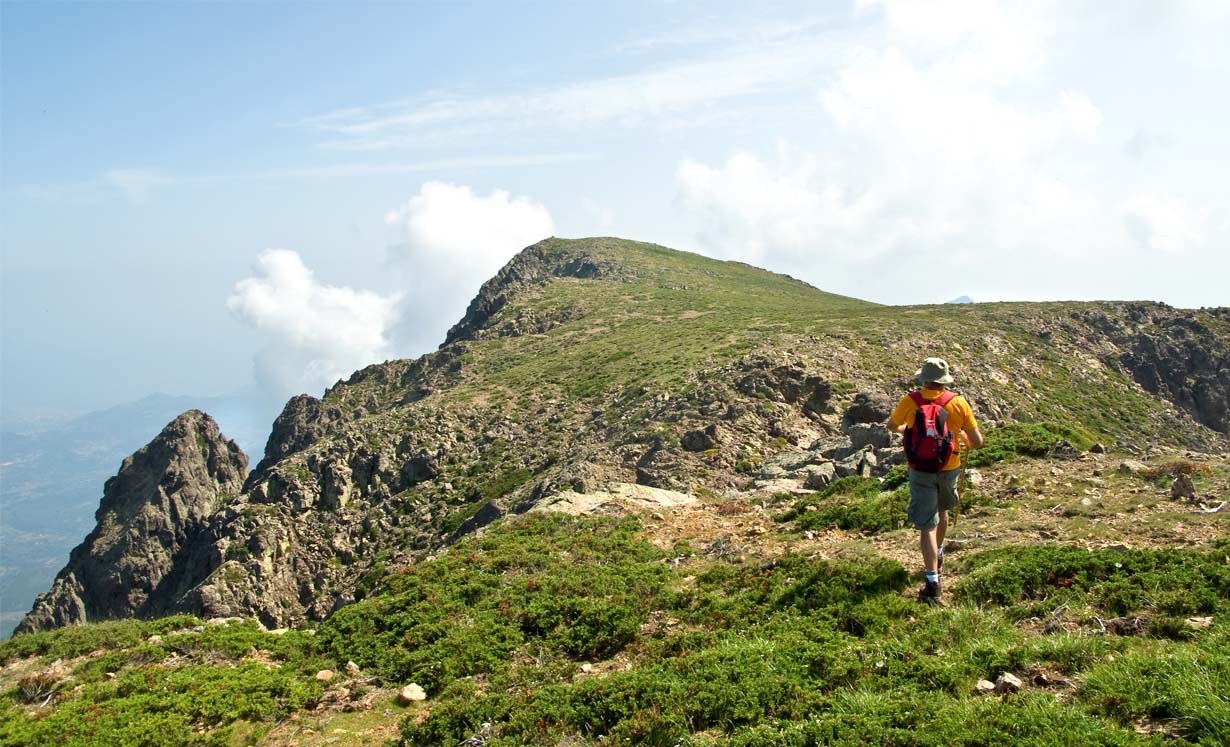
Southern Corsica, with its wild character and breathtaking scenery, is much more than just a seaside destination. It’s a life-size playground for adrenaline junkies andsports adventure enthusiasts.
Between the turquoise waters of the Mediterranean, the sharp granite mountains and the impetuous rivers that criss-cross the maquis. This territory offers a unique concentration of activities to push back your limits and live intense experiences.
Whether you’re drawn to the depths of the sea, dizzying peaks or speed on the water, South Corsica promises thrills and unforgettable memories. Discover our selection of the best sporting adventures not to be missed during your next stay.
Aquatic Challenges: Immersion and Strong Sensations
Canyoning: In the Heart of the Wild Rivers
Canyoning is one of South Corsica’s most emblematic sporting adventures. It involves descending steep riverbeds, combining aquatic walking, swimming, jumping into crystal-clear pools, sliding down water-polished natural slides and abseiling down refreshing waterfalls.
It’s a total immersion in raw, unspoilt nature, often otherwise inaccessible. The Bavella region, in particular, abounds with renowned courses such as Pulischellu, ideal for a family initiation with its playful jumps and slides, or the more technical Vacca and Purcaraccia, reserved for seasoned sportsmen in search of thrills and grandiose landscapes.
The canyoning experience in Southern Corsica is unique. Imagine yourself moving through crystal-clear water, surrounded by impressive granite walls and lush vegetation. Each obstacle is a source of intense satisfaction, each basin an invitation to pause and contemplate in a setting of wild beauty.
It has to be said that the water temperature, even if cool, is generally invigorating on hot summer days. So this activity will be a refreshing and dynamic interlude.
Safety is paramount in this discipline, so it’s imperative to use qualified professional guides. These experts know the canyons inside out, adapt the itinerary to hydrological and weather conditions, and provide all the necessary equipment (neoprene wetsuit, helmet, harness).
Many service providers offer outings from the main tourist areas or campsites, making it easy to organize this unforgettable adventure. Some courses even include zip lines over the water, adding an aerial dimension to this aquatic descent.
Scuba Diving: Exploring the Mysterious Depths
Scuba diving represents another major sporting adventure in Southern Corsica, offering a fascinating exploration of a silent and colorful world. The region’s exceptionally clear waters, with visibility often in excess of 20 to 30 meters, allow you to fully appreciate the richness of the Mediterranean seabed.
The Bouches de Bonifacio Nature Reserve, a vast protected area, is a sanctuary for remarkable biodiversity. Diving here gives you the chance to observe curious groupers, schools of silver barracuda, discreet moray eels and colorful capons in their natural habitat.
The dive sites are numerous and varied, catering for beginners and experienced divers alike. The Lavezzi Islands, a rounded granite archipelago, offer shallow dives rich in life, ideal for first dives or photographic explorations.
For certified divers, the secs (rocky ascents) like that of Les Moines near Ajaccio or the vertiginous drop-offs along the coast or around the Cerbicales islands promise pelagic encounters. They also promise spectacular underwater scenery.
What’s more, several wrecks, witnesses to local maritime history, lie at depths accessible to technical divers. This adds a historical dimension to the underwater adventure.
The South Corsican diving experience is enhanced by the quality of the infrastructure and the professionalism of the local diving centers. These offer internationally-recognized training courses (PADI, FFESSM/CMAS) and outings supervised by passionate instructors who know the specificities of each site inside out.
The fact is, diving in Corsica is like taking a break from time, an active meditation in the heart of a preserved environment of breathtaking beauty.breathtaking beauty. Reservations are highly recommended, especially in summer, to guarantee your place on the boats and benefit from optimal supervision.
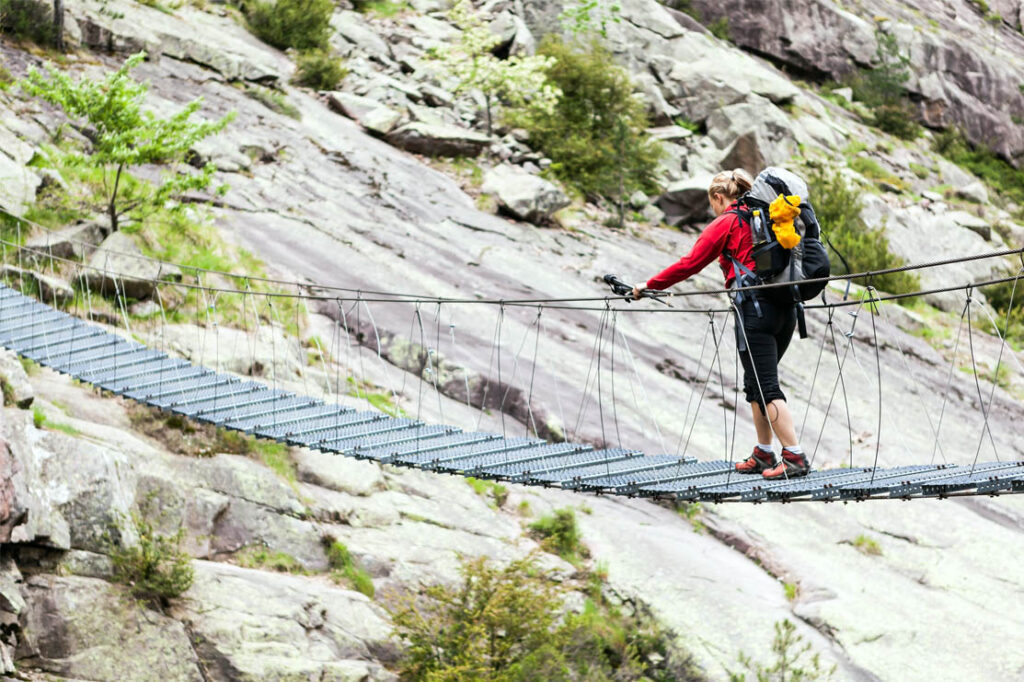
Aventures Terrestres: Defying the Corsican Reliefs
Active hiking on mountain trails
Hiking in Southern Corsica takes on asporting adventure dimension as soon as you leave the coastal paths to tackle the mountainous terrain of the interior. The famous GR20, which crosses the island from north to south, has some of its most emblematic and demanding sections in its southern part.
The stages around the Aiguilles de Bavella, with their spectacular granite landscapes and sometimes aerial passages, are a major challenge for seasoned hikers. The raw beauty of the area, with its wind-tortured laricio pines and color-changing rock formations, is well worth the effort.
Beyond the GR20, many other mountain routes offer sporting challenges and unforgettable panoramas. Climbing Monte Incudine, South Corsica’s highest point at 2134 metres, is a long and demanding hike, but at the summit offers 360-degree views over much of the island, from the Tyrrhenian Sea to the Sardinian Sea.
In theOspedale massif, trails leading to the Piscia di Gallu waterfall or the Coscione plateau pass through majestic pine and beech forests, punctuated by spectacular views over the Gulf of Porto-Vecchio.
These challenging hikes require excellent physical condition, meticulous preparation and appropriate equipment. Corsican terrain is often rocky and technical, and gradients can be considerable. Mountain weather can also change very quickly, even in midsummer, so it’s always advisable to bring warm, waterproof clothing.
For those wishing to discover these itineraries in complete safety, the services of a qualified mountain leader are highly recommended. These local professionals share not only their technical expertise, but also their intimate knowledge of the area’s history, flora and fauna, greatly enriching the adventure.
Climbing and Via Ferrata: Assaulting the Granite Walls
The omnipresent granite of southern Corsica makes this region a paradise forclimbing and via ferrata enthusiasts. The rock faces, often located in exceptional natural settings, offer a multitude of routes suitable for all levels, from beginner to expert climber.
The Aiguilles de Bavella is our most emblematic climbing site, with hundreds of routes carved out of rock with a reputation for exceptional grip. To climb Bavella is to evolve in a grandiose setting, between soaring granite towers and deep forests, with breathtaking views of the surrounding mountains.
For those who prefer a safer approach to verticality, via ferrata is an ideal option. These itineraries along rock faces, equipped with cables, ladders and monkey bridges, allow you to progress at great heights while being constantly assured of your safety.
The Chisa site, not far from Solenzara, offers two routes of increasing difficulty, with guaranteed thrills and magnificent panoramas over the valley and the sea in the distance. Other via ferrata, such as Tollevone near Zonza, offer similar experiences in equally spectacular settings.
These vertical sports adventures require specific equipment (harness, helmet, via ferrata lanyard, climbing shoes) and a good knowledge of safety techniques. For beginners, it’s essential to be accompanied by a professional guide.
Many guide offices and specialized service providers offer half-day or full-day introductions, providing all the necessary equipment and safe supervision. Climbing or via ferrata in South Corsica often allows you to discover otherwise inaccessible viewpoints, offering a unique perspective on the island’s wild beauty.
Enduro and Downhill MTB : Descending Technical Slopes
Mountain biking takes on a particularly adventurous dimension in Southern Corsica when you venture onto the technical trails and downhill courses that criss-cross the inland mountains. Far from the coastal cycle paths, these itineraries are for experienced mountain bikers, equipped with the right gear (full-suspension mountain bikes, protective gear) and in good physical condition.
The region offers enormous potential forEnduro and Downhill (DH) riding, with significant vertical drops and a wide variety of terrain.
TheOspedale massif, with its pine forests and granite chaos, offers several renowned enduro routes. These routes combine demanding uphill sections with playful, technical downhill sections, alternating fast forest passages, rocky crossings and sharp bends.
Views of the Gulf of Porto-Vecchio from certain points on the trails add a panoramic dimension to the sporting effort. Likewise, the Bavella region offers more challenging descents, on trails originally designed for hiking and redeveloped by local enthusiasts.
It is important to note that mountain biking in Corsica requires a good knowledge of the terrain and local conditions. Many trails are not specifically marked for mountain biking, and their maintenance can be irregular. It is therefore strongly recommended to hire a local mountain bike guide or to take part in outings organized by specialized outfitters, at least for a first discovery.
These professionals know the best itineraries, adapt the route to your technical level and provide assistance in the event of mechanical problems. Some service providers even offer shuttle services to high-altitude starting points, so you can concentrate on the pleasure of the ride. This sporty mountain-biking adventure offers a dynamic and exhilarating exploration of the Corsican hinterland.
Maritime Exploration: Freedom and Discovery
Sea Kayaking: Paddling to Isolated Horizons
Sea kayaking offers a quiet, intimate approach to exploring the hidden treasures of the South Corsican coastline. This light, maneuverable craft lets you weave along rocky coasts, enter sea caves inaccessible to larger boats, and dock on deserted beaches for a peaceful swim.
It’s a gentle sporting adventure that favors discovery at the rhythm of the paddle and a deep connection with the marine environment.
The itinerary possibilities are endless, from outings lasting just a few hours to self-guided multi-day hikes. The Bouches de Bonifacio nature reserve is anexceptional place to explore, with its sculpted limestone cliffs, turquoise waters and numerous protected coves.
Paddling at the foot of the Bonifacio cliffs or exploring the Lavezzi Islands (in authorized areas) is a unique experience. Further north, the wild coastline between Campomoro and Tizzano offers unspoilt landscapes where nature reigns supreme, with numerous bivouac possibilities for long-distance hikers.
Kayak rentals (single or double, decked or sit-on-top) are widely available at local watersports centers and campsites. For beginners or those wishing to discover the best routes without worrying about navigation, outings accompanied by qualified guides are available.
These professionals share not only their technical expertise but also their passion for the marine environment, transforming a simple outing into a true experience of naturalistic discovery. Sea kayaking is an active, environmentally-friendly way to experience the unique beauty of Corsica’s coastline.
Jet Ski: Speed and Coastal Exploration
Jet skiing combines the adrenalin of speed with the freedom to explore vast stretches of the South Corsican coastline. This motorized sporting adventure is seductive for its ability to cover large distances quickly, allowing you to discover a variety of sites in a single outing, including the emblematic beaches of Palombaggia, the cliffs of Bonifacio and the wilder coves of the surrounding area.
It’s a dynamic and exhilarating way to experience the diversity of Corsica’s coastal landscapes.
Two main formulas are available to enthusiasts: free charter (requiring a boating license or temporary license) and guided tours. Free rental offers maximum autonomy within a defined perimeter, ideal for experienced pilots wishing to sail at their own pace.
Guided hikes, supervised by a professional instructor, are perfect for beginners or those who want to discover the most beautiful routes in complete safety, with commentary on the sites visited and swimming stops in privileged spots.
The main rental centers are concentrated around major tourist areas such as Porto-Vecchio, Bonifacio, Propriano and the Gulf ofAjaccio. It’s important to comply scrupulously with the regulations in force: speed limits near the coast and in harbors, no sailing in bathing areas and integral nature reserves.
Compliance with these rules is essential to guarantee everyone’s safety and preserve the exceptional marine environment of Southern Corsica. Despite these necessary constraints, jet skiing remains an exciting option for a fast, fun way to discover the coastline.
Aerial Sensations: Paragliding over the beauty of Corsica
Paragliding offers a unique and breathtaking perspective on the landscapes of southern Corsica. Soaring from the heights to fly silently over jagged coastlines, turquoise beaches and verdant scrubland gives you an incomparable feeling of freedom.
This aerial sporting adventure, although requiring specific weather conditions, is accessible to all, thanks to tandem flights with qualified professional instructors.
There are several renowned take-off sites in southern Corsica. The Cupabia site, in the Gulf of Valinco, is particularly popular for its often favorable aerological conditions and its exceptional panorama of the bay and surrounding mountains.
Other spots, such as those above the beaches of Palombaggia or nearAjaccio, also offer memorable flights with breathtaking views of the coastline. The flight generally lasts between 15 and 30 minutes, a suspended moment when you let yourself be carried along by the air currents, contemplating the beauty of the island from an unprecedented angle.
Booking a paragliding flight is simple and can often be organized directly from your campsite in Southern Corsica. Local service providers are in constant contact with campsites and can inform you of the best conditions for flying. It’s important to remember that paragliding depends entirely on the weather, and in particular on the strength and direction of the wind.
A certain amount of flexibility is therefore required, but the wait is amply rewarded by the intense emotion and lasting memories of a paragliding flight over Corsica. It’s a poetic and environmentally-friendly way to take in the immensity and diversity of the island’s landscapes.
Preparing your sporting adventure in South Corsica
Essential Equipment and Safety Tips
Sporting adventures in Southern Corsica require appropriate equipment and special attention to safety rules. For land-based activities (hiking, mountain biking, climbing), quality footwear is essential: hiking boots for the mountains, approach boots for climbing/via ferrata, specific mountain bike boots.
Sun protection (factor 50+ cream, hat, glasses) is essential, as is a sufficient water supply (minimum 1.5L per person for half a day). A small first-aid kit and a charged telephone complete the basic equipment.
For water activities (canyoning, diving, kayaking, board sports), specific equipment is generally provided by the service providers (wetsuits, life jackets, helmets, diving gear, etc.). However, you’ll need to bring your own swimsuit, microfiber towel, UV protection lycra and water shoes. For snorkeling, your own mask and snorkel are recommended.
It is important to listen carefully to the safety briefings before each activity and to follow the instructions given by the instructors. Never overestimate your physical and technical abilities, and don’t hesitate to abandon or adapt the activity in case of fatigue or unfavorable conditions.
Safety also means being well informed. Before setting off on a self-guided hike, check the weather forecast and tell someone your itinerary and expected return time. For activities at sea, check the weather forecast and respect authorized navigation zones.
In the mountains or at sea, be aware that the telephone network may be limited; an offline mapping application or GPS locator may prove useful. The European emergency number is 112. Respecting these simple rules will greatly contribute to the success of your sporting adventures in Southern Corsica.
Choosing the Right Period and Qualified Service Providers
The time of year of your stay greatly influences the possibilities forsporting adventure in Southern Corsica. Spring (April-June) is ideal for hiking, mountain biking and climbing, with mild temperatures and nature in full bloom. Summer (July-August) is perfect for water-based activities, but the heat can make land-based endeavors difficult in the hottest hours.
Autumn (September-October) offers an excellent compromise, with pleasant temperatures, still-warm water and magnificent colors, ideal for combining land and sea activities.
The choice of service providers is essential to guarantee the quality and safety of your experience. Choose structures employing instructors and guides with state qualifications in their respective disciplines (BEES, DEJEPS, mountain leader, etc.).
Check that the equipment provided is recent and well-maintained. Don’t hesitate to consult the online reviews or ask for advice at the reception of your campsite in Southern Corsica, which often works with reliable, recognized local partners.
Advance booking is strongly recommended, especially in high season, for the most popular activities such as canyoning, diving or very specific boat excursions. For activities that depend heavily on the weather (paragliding, kitesurfing), a pre-booking with confirmation the day before or the same day is often the best approach.
Ultimately, good planning, combined with the choice of qualified professionals, is the key to fully and serenely experiencing the sporting adventures in South Corsica.
FAQ : Your Questions about Sports Adventures in South Corsica
What level of fitness is required for these sporting adventures?
The level required varies considerably depending on the activity and itinerary chosen. Some activities, such as snorkeling, paddleboarding or coastal hiking, are accessible to anyone in good health. Others, such as sport canyoning, long-distance climbing, enduro mountain biking or the difficult stages of the GR20, require excellent physical condition and previous experience.
It’s essential to choose activities suited to your level and not to overestimate your abilities. Professional service providers are there to advise you and adapt the activity to your needs.
Is it dangerous to practice these sports in South Corsica?
Like any outdoor activity in a natural environment, these sports involve inherent risks. However, by calling on the services of qualified professionals, using appropriate equipment and complying with safety instructions, the risks are considerably reduced.
Corsica has its own special characteristics (heat, rugged terrain, changeable weather) that call for particular vigilance. Good preparation and a responsible attitude are the best guarantees of safe riding.
Can these activities be enjoyed all year round?
Some activities can be enjoyed almost all year round, such as low and medium-altitude hiking and mountain biking. Others are more seasonal: water sports are mainly concentrated from April to October; canyoning is highly dependent on river flow (ideal from May to September); hiking in the high mountains is limited by snow from November to May/June.
Paragliding depends on aerological conditions, which are possible all year round but more frequent in spring and summer.
What’s the budget for a sports adventure holiday?
Budgets vary widely. Supervised activities generally cost between €60 and €150 per person for a half or full day (canyoning, diving, paragliding, mountain bike/hiking guide, etc.). Equipment rental (kayak, paddle, mountain bike) ranges from €30 to €60 per day.
For a week-long stay combining several supervised activities and independent practice, plan on an “activities” budget of €300 to €500 per person, in addition to accommodation and living expenses. Choosing a campsite in South Corsica can often reduce the overall cost of your stay.
How can I find qualified guides and instructors?
The best way to do this is to contact your local guide office, tourist office or campsite reception, which usually have lists of approved professionals. You can also consult the websites of national sports federations (FFME for climbing, FFCK for kayaking, FFVL for paragliding, etc.), which list approved structures.
Always check that the instructor holds a state diploma appropriate to the activity on offer, as well as professional liability insurance.
Is it possible to combine several sporting adventures in one day?
Yes, it’s perfectly possible, and even recommended, to vary the pleasures! For example, a morning of hiking can be followed by an afternoon of paddling or snorkeling. A canyoning trip can end with a swim in the sea.
Some providers even offer “multi-adventure days” combining via ferrata and canyoning, for example, or kayaking and coastal hiking. The important thing is to plan the sequence of activities carefully, taking into account travel times and physical fatigue.
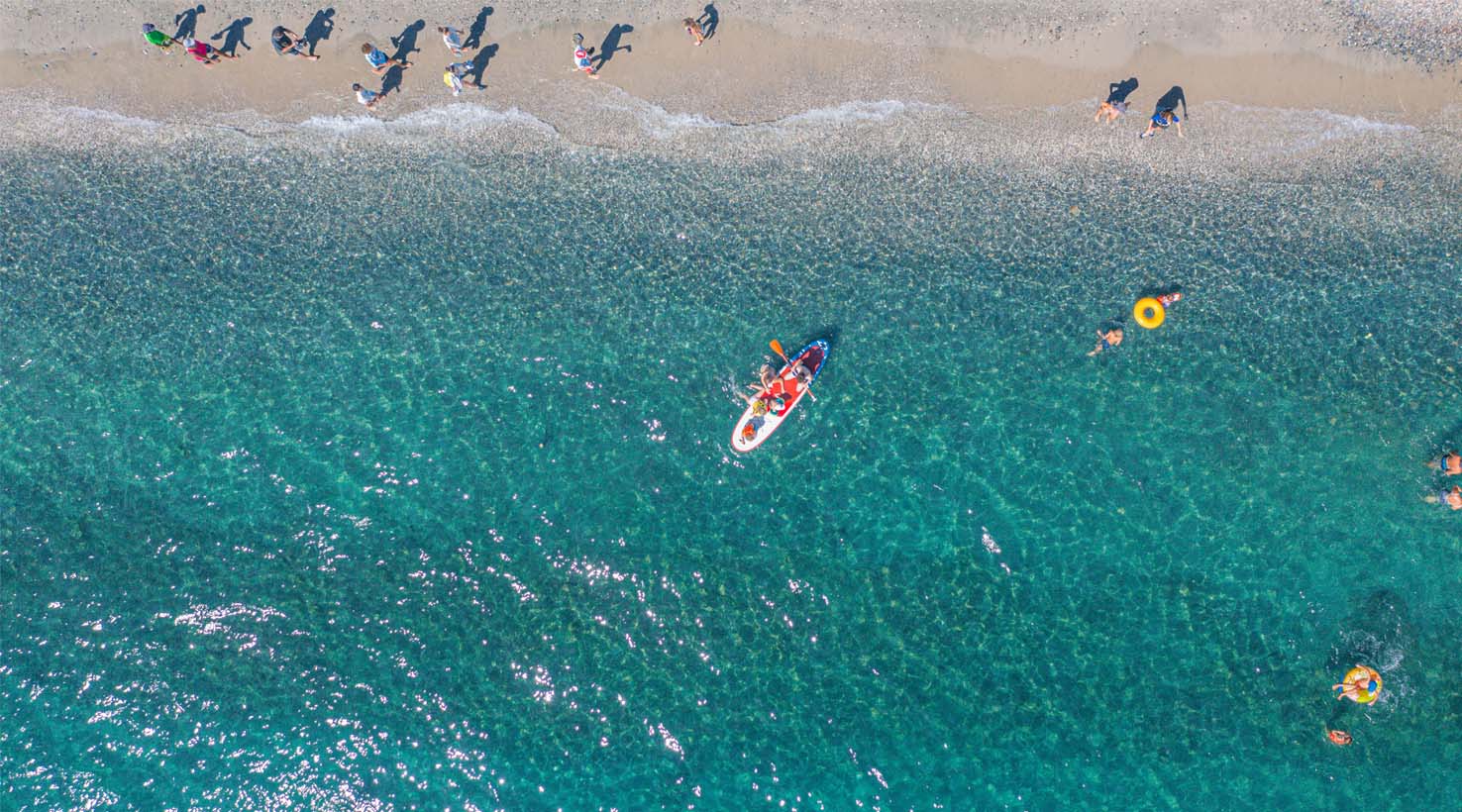
South Corsica, with its crystal-clear turquoise waters, postcard-perfect sandy beaches and indented coastline offering secret coves and majestic cliffs, is a dream destination forwater sports enthusiasts.
In summer, when the Mediterranean sun generously warms the island and the sea, the opportunities to enjoy this exceptional marine environment multiply.
Whether you’re looking for thrills, peaceful exploration or family relaxation, South Corsica’s diverse range of water sports activities is sure to meet your every expectation. Here are our Top 10 must-do water sports activities for your next summer holiday on the Isle of Beauty.
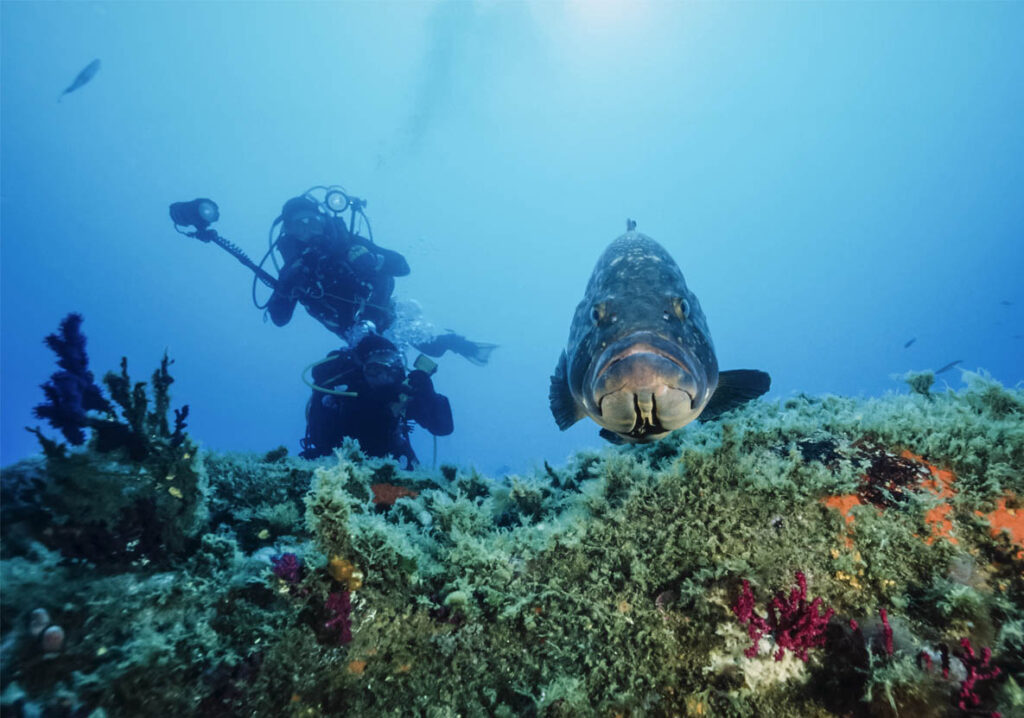
Explore the Underwater Wonders: Diving and Snorkeling
1. Scuba Diving: Immersion in a Natural Aquarium
Scuba diving in Southern Corsica is undoubtedly one of the most memorable experiences. The region’s seabed offers exceptional visibility, frequently exceeding 20 to 30 meters, and preserved biodiversity, particularly in the Bouches de Bonifacio Nature Reserve.
This protected area, the largest in mainland France, is home to rich ecosystems where brown groupers, dentex, moray eels and sometimes even sea turtles evolve in a spectacular setting of granite rocks and posidonia meadows.
Many professional professional diving centersbased mainly in Porto-Vecchio, Bonifacio and Propriano, offer outings to suit all levels. For beginners, a first dive is a gentle and safe introduction to the underwater world, supervised by an experienced instructor.
These first dives usually take place in sheltered shallow coves. For certified divers, the options are vast: wreck exploration, dives on secs (underwater rocky ascents) or along vertiginous drop-offs like those of the Lavezzi Islands.
Note that the water temperature in summer (between 22°C and 26°C) makes diving particularly pleasant. For this reason, we strongly recommend that you book your outings, especially in July and August, as places on the boats are limited to guarantee the quality of supervision and safety.
Some clubs even offer themed dives, such as grouper spotting or underwater photography, adding an extra dimension to this already fascinating activity.
2. Snorkeling : Discovery for everyone
For those who prefer to stay on the surface, or to introduce the younger ones to the beauties of the underwater world, snorkeling represents an ideal and accessible alternative. This simple activity, requiring only minimal equipment (mask, snorkel and possibly flippers), lets youexplore the first few meters below the surface, where marine life is often the densest and most colorful.
Southern Corsica abounds in perfect snorkeling spots, characterized by calm, transparent waters and varied rocky or sandy bottoms.
Emblematic beaches such as Palombaggia, Santa Giulia or Rondinara offer great observation opportunities along the rocks that line their extremities. However, the more secluded coves, often accessible after a short walk or by boat, usually hold the best surprises.
The area around Bonifacio, with its small calanques and emerald waters, or the shores of the Lavezzi Islands (in authorized areas) are paradises for snorkeling enthusiasts. It’s easy to spot girelles, sars, starfish and sometimes even small moray eels hiding in the crevices.
Many marine tour operators systematically include snorkeling breaks in their tours, often providing the basic equipment. That said, having your own equipment guarantees greater comfort and optimal hygiene.
It’s worth noting that this activity can be practiced completely independently from any accessible beach or cove. Simply choose a site sheltered from the wind, check the sea conditions and let yourself float to admire the silent spectacle unfolding before your eyes. It’s a simple and economical way to connect with the exceptional marine environment of Southern Corsica.
Glide on the Turquoise Waters: Paddle and Kayak
3. Stand-Up Paddle (SUP): Peaceful coastal exploration
Stand-Up Paddle (SUP) has conquered Corsican coasts in recent years, offering a unique and environmentally-friendly way to explore the coastline. Standing on a wide, stable board, equipped with a paddle, you glide silently over the water, enjoying a privileged view of the seabed and coastal landscapes.
This relatively easy-to-learn activity is suitable for all ages and fitness levels. The calm waters of South Corsica‘s sheltered bays, such as those of Pinarello, Figari or Valinco, are particularly suitable for the initiation and serene practice of SUP.
Paddleboarding gives you access to otherwise inaccessible areas. You can walk along cliffs at your own pace, enter small sea caves when the sea is calm, or discreetly approach wildlife without disturbing it.
It’s also an excellent way to reach deserted coves for a swim away from the crowds. In fact, some windsurfers even use their boards for yoga or meditation sessions on the water, taking advantage of the morning calm and the exceptional setting.
Paddle boards are widely available for hire on the beaches and in the watersports centers of southern Corsica. You can expect to pay between €15 and €25 per hour. For a more supervised experience, guided SUP tours are available, enabling you to discover the most beautiful routes under the guidance of a local instructor.
These outings often include explanations of the environment and sometimes even a tasting of local produce in a secluded cove. The fact is, SUP is a complete activity, combining gentle physical effort, contemplation and environmental discovery.
4. Sea Kayaking: Adventure and closeness to nature
Sea kayaking offers another fascinating way to explore the rugged coastline of southern Corsica. Sitting flush with the water, you benefit from a unique proximity to the marine element and the ability to thread your way through narrow passages or low caves inaccessible to other craft.
More stable and less dependent on wind conditions than the paddle, the kayak allows you to cover longer distances and envisage trips lasting several hours or even a full day.
The itinerary possibilities are endless. The descent from Campomoro Bay to Senetosa Point, along a wild, unspoilt coastline, is a classic, but as spectacular as ever.
Exploring the area around Roccapina, with its famous lion-shaped rock and translucent coves, is another popular option. For the more adventurous, multi-day hikes with bivouacs on isolated beaches can be organized, offering total immersion in Corsican nature.
Kayaks (single or double) are available for hire at many of Corsica’s marinas and campsites. Outings accompanied by qualified guides are also available, particularly recommended for beginners or for exploring more technical or isolated areas.
These guides share not only their expertise in navigation, but also their in-depth knowledge of the local fauna, flora and history. Kayaking is a particularly quiet activity, increasing the chances of observing marine wildlife in its natural environment without disturbing it.
Thrills and adrenaline on the water
5. Jet Ski: Speed and Freedom of Exploration
For lovers of speed and thrills, jet ski rental in Southern Corsica is a must. Piloting these powerful machines on turquoise waters offers a guaranteed adrenalin rush, while allowing you to quickly discover large stretches of coastline.
The main rental centers are located around Porto-Vecchio, Bonifacio, Propriano and in the Gulf of Ajaccio, offering recent, well-maintained machines.
Several formulas are generally available. Free rental (with boating license or temporary license) gives you total freedom to explore within a defined perimeter, ideal for those who have already mastered piloting.
For beginners or those wishing to discover the most beautiful sites without worrying about navigation, guided excursions are the perfect option. Supervised by a qualified instructor, these excursions combine the pleasure of speed with the discovery of secret coves, sea caves and inaccessible beaches. Lengths vary from 30 minutes to several hours, with prices to match.
It should be noted that jet skiing is strictly regulated in Corsica for safety and environmental protection reasons. Boating is generally prohibited in the 300-meter strip near the coast (except in marked channels) and in nature reserves.
Serious service providers will tell you exactly what these rules are during the initial briefing. Despite these necessary constraints, the potential for exploration remains immense and the sensations of and the sensations of freedom and speed and the sensations of freedom and speed provided by jet skiing remain exceptional in the sumptuous setting of southern Corsica.
6. Towed Boats: Guaranteed Laughs with Family and Friends
The towed buoy is the ultimate water sports activity, promising laughter and thrills for almost everyone. Attached to an inflatable buoy in a variety of shapes (round, banana, sofa, etc.), you are towed at high speed by a motorboat, bouncing on the waves and negotiating turns with varying degrees of stability! This activity requires no special skills, apart from good manners and a love of splashing.
It’s an ideal option for groups of friends or families with teenagers looking for a fun, dynamic activity. Sessions generally last between 10 and 15 minutes, enough to provide a good dose of adrenalin without excessive exhaustion.
The speed and tricks performed by the boat’s pilot can be adapted to suit the age and wishes of the participants, ranging from a simple fast ride to tight turns guaranteeing a few refreshing falls.
Numerous watersports centers located on the most popular beaches of southern Corsica (Santa Giulia, Palombaggia, Campomoro, Ajaccio beaches…) offer this activity at reasonable rates (around €20-25 per person). It’s often the “pleasure” activity you indulge in at the end of a beach day.
In fact, some buoy models, such as the “flyfish”, are even designed to lift off slightly from the water during acceleration, adding an aerial dimension to the experience! Safety is assured by the compulsory wearing of life jackets and the supervision of experienced professionals.
Mastering the Elements : Wind and Waves
7. Windsurfing: Glisser au Gré du Vent
Windsurfing conditions in Southern Corsica are often ideal. The regular afternoon thermal breezes that blow across many bays provide a perfect playground for beginners and experienced windsurfers alike.
This activity, which combines the glide of surfing with the propulsion of wind captured by a sail, offers unique sensations of freedom and communion with the elements.
Several spots stand out in particular. The bay of Sant’Amanza, near Bonifacio, is renowned for its often strong winds and relatively flat water, ideal for slalom and freeride. The more sheltered Gulf of Valinco offers milder conditions, perfect for beginners and advanced riders.
On the west coast, beaches such as Capo di Feno can offer great waves in westerly winds, attracting waveriding enthusiasts.
Numerous schools and sailing centers offer courses and workshops for all levels, as well as rental of suitable equipment. Learning to windsurf requires a little perseverance, but the first gliding sensations are quickly accessible, especially with the wide, stable boards used for initiation.
For holidaymakers staying at a campsite in Southern Corsica, this activity represents an excellent opportunity to learn a complete and ecological water sport, taking advantage of the windy afternoon conditions after a quieter morning devoted to other discoveries.
8. Kitesurfing: The Aerial Alliance of Gliding and Flying
Kitesurfing, the spectacular sport of gliding on a board towed by a large kite, has also found internationally renowned spots in South Corsica. This demanding but rewarding discipline offers intense sensations, combining speedy gliding with impressive aerial jumps for the most experienced practitioners.
The Piantarella spot, a shallow lagoon facing the Lavezzi Islands near Bonifacio, is without doubt Corsica’s most famous kitesurfing spot. Its ideal orientation in relation to the prevailing winds and the safety offered by its shallow depths make it an ideal place to learn and practice.
Other sites such as La Tonnara or certain beaches on the eastern coast also offer excellent conditions, depending on the wind direction.
For safety reasons, learning to kitesurf requires professional supervision. Several specialized schools offer introductory courses over several days, covering the essential aspects of kite piloting, board management and safety rules.
It’s worth noting that progress can be rapid, often enabling you to make your first tack as soon as the initial course is over. For self-sufficient kitesurfers, equipment rental is available, but it’s essential to find out about local conditions (take-off/landing zones, navigation rules) before taking to the water.
The spectacle of the colorful wings moving over the turquoise waters is in itself a remarkable visual attraction, even for simple spectators on the beach.
Unique and Refreshing Maritime Experiences
9. Hidden Treasures Boat Tours
Visit boat excursions are a privileged way to discover the inaccessible wonders of the South Corsican coastline. Whether aboard speedboats to cover long distances or more traditional craft for a slower approach, these sea outings open up unique perspectives on emblematic sites and secret coves.
The most popular tours generally include a visit to the Bonifacio cliffs from the sea, exploration of the surrounding sea caves, and a sail to the Lavezzi islands. These excursions, departing from Bonifacio or Porto-Vecchio, offer a condensed view of the natural beauty of the far south in a half or full day.
They often include swimming stops in crystal-clear waters and enlightening commentaries by the captains on local history, geology and wildlife.
For a more personalized experience, chartering a boat with or without a skipper lets you define your own itinerary and linger at the sites that appeal to you most. This option offers incomparable freedom to discover secluded anchorages, picnic on a deserted beach or simply soak up the sun away from the hustle and bustle.
Many campsites in Southern Corsica can put you in touch with reliable local charter companies or professional skippers who know the secrets of the coast inside out. Interestingly, some excursions combine maritime discovery with land-based activities, such as a hike along a part of the coastal path accessible only by boat.
10. Coastal Canyoning: Aquatic Adventure between Sea and River
Although traditionally associated with the inland mountains, canyoning also finds fascinating expression in the immediate vicinity of the coastline in southern Corsica. Some rivers flow directly into the sea, creating so-called “coastal” canyoning routes that offer a unique combination of fresh and salt water, waterfalls and natural pools overlooking the Mediterranean.
The Baracci canyon, near Propriano, is the most emblematic example of this type of course. Its lower section practically ends at the beach, providing a spectacular transition between the canyon’s mineral and aquatic universe and the blue immensity of the sea.
This moderately-difficult descent is accessible to beginners and families (children aged 10-12 and over) and features a succession of natural slides, small jumps and swimming passages in crystal-clear pools.
Other, lesser-known coastal canyons exist along the southern coast, often revealed by local guides who adapt their outings according to hydrological conditions and demand. These routes offer an original alternative to classic mountain canyoning, with the added advantage of being able to conclude the adventure with a refreshing swim in the sea.
As with all canyoning, supervision by a qualified professional is essential to guarantee safety and provide the specific equipment required. Numerous campsites in Southern Corsica offer reservations for these activities, making it easy to organize this unique aquatic adventure. It’s an original way to combine the pleasures of the river and the sea in one memorable day.
FAQ : Your questions about water sports in South Corsica
Do I need to book water sports activities well in advance in summer?
Yes, for most popular activities such as jet skiing, diving (especially guided hikes), boat trips to popular sites (Lavezzi, Scandola) and canyoning, it’s strongly recommended to book at least 3 to 5 days in advance in July and August.
For some very specific activities or the most reputable suppliers, a week’s notice may be necessary. For simple rentals (paddle, kayak), same-day or day-ahead booking is often possible, but anticipation guarantees availability of equipment.
What’s the average budget for a day of water sports?
The budget varies considerably depending on the activities chosen. Expect to pay around 60-80€ for a canyoning or scuba-diving trip, 50-70€ for a 3-4h boat trip, 100-150€ for a 1h30 guided jet ski tour, and 40-60€ for a half-day paddle or kayak rental.
A day combining several activities can represent a budget of €150 to €250 per person. To keep costs under control, alternate paid supervised activities with free independent activities such as snorkeling from the beach.
Are water sports activities suitable for children?
Yes, many activities are suitable for children, with varying minimum ages. Snorkeling is accessible as soon as they can swim with mask and snorkel. Towed buoys are generally available from age 6-8. Paddleboarding and kayaking can be enjoyed by the whole family, with children’s berths on double kayaks or adapted boards.
Jet skis are available for passengers (from 8-10 years of age, depending on the center). Diving baptisms are often offered from age 8. For canyoning, “family” courses are available from 8-10 years. Always check the minimum age when booking.
Do I need special equipment for these activities?
For most supervised activities (diving, canyoning, guided jet skiing, boating), specific equipment is supplied by the service provider (wetsuit, life jacket, helmet, etc.). For rentals (paddle, kayak, snorkeling), basic equipment is included.
However, we recommend that you bring: swimsuit, towel, water-resistant sun cream, sunglasses with drawstring, hat/cap, and possibly UV protection lycra and water shoes. For snorkeling, it’s best to bring your own mask and snorkel for comfort and hygiene.
Where to find the best spots for each activity in South Corsica?
Spotlights vary depending on the activity:
- Diving/Snorkeling: Bonifacio reserve, Lavezzi islands, west coast (around Porto Pollo, Tizzano).
- Paddle/Kayak: Sheltered bays (Santa Giulia, Rondinara, Valinco, Figari).
- Jet Ski: Ajaccio and Valinco gulfs, Porto-Vecchio, Bonifacio.
- Towed buoy: Large tourist beaches (Palombaggia, Santa Giulia, Ajaccio beaches).
- Windsurfing/Kitesurfing: Sant’Amanza, Piantarella, La Tonnara, Valinco.
- Coastal canyoning: Baracci near Propriano.
- Boat excursions: Departures from Bonifacio, Porto-Vecchio, Propriano, Ajaccio.
Are there any special precautions to take at sea in Southern Corsica?
Yes, always check the marine weather forecast before setting out, especially for self-guided activities. Beware of thermal breezes , which often pick up in the afternoon and can make it difficult to return by paddle or kayak. Respect swimming areas and safety distances from other boats. Protect yourself effectively from the sun, as reverberation off the water is intense.
Take plenty of water with you. In nature reserves, scrupulously respect regulations (speed limits, prohibited zones, no fishing or collecting). When in doubt, always opt for an outing supervised by local professionals.
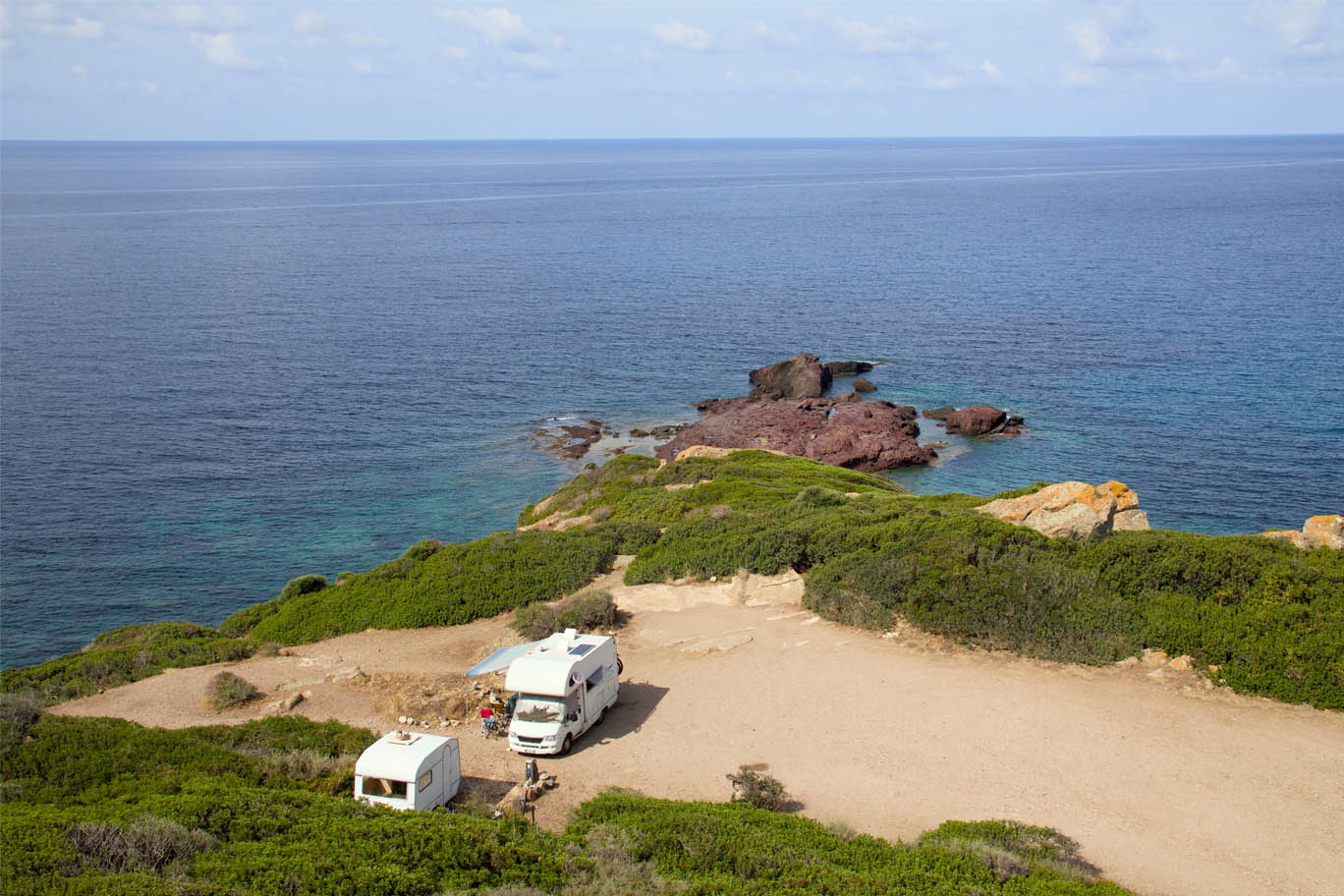
Discover the beauty of South Corsica with Corsica Camping, your ideal partner for unforgettable holidays . unforgettable vacations by motorhome. You’ll enjoy a selection of the island’s best campsites, offering privileged pitches close to beaches, mountains and authentic villages.
Thanks to Corsica Camping, you’ll have easy access to practical information on parking areas, must-see itineraries and tips for maximizing your experience. Let yourself be seduced by Corsica’s unspoilt nature and rich culture, while you travel in complete freedom!
Must-see motorhome itineraries
Southern Corsica is full of treasures to discover, and motorhoming is undoubtedly one of the most interesting ways to explore the region in depth. If you’re looking for itineraries that will enable you to take full advantage of the wonders of this part of the island, there are :
The west coast and the Calanques de Piana
This itinerary takes you along one of the most spectacular coastlines in the Mediterranean. Start in Ajaccio, the regional capital, famous for being the birthplace of Napoleon Bonaparte.
Then head north along the coastal road. You’ll pass Sagone and its beautiful beach, before reaching Cargèse, a picturesque village known for its two churches, one Catholic and the other Orthodox, facing each other.
Continue on to Porto, gateway to the Calanques de Piana, a UNESCO World Heritage site. These glowing rock formations plunging into the sea offer a breathtaking spectacle.
Don’t forget to stop off for a hike or a boat trip. However, you should also be aware that some stretches of road are narrow and winding. So drive carefully and take your time to enjoy the many viewpoints along the way.
The wild south: from Sartène to Bonifacio
With this itinerary, discover the southernmost part of the island, renowned for its wild beauty. Start in Sartène, nicknamed“the most Corsican of Corsican towns“. Its narrow streets and granite houses bear witness to its rich past.
Continue south through the Alta Rocca region, famous for its cork oak forests and hilltop villages. Take a detour to the prehistoric site of Filitosa, home to fascinating statue-menhirs.
Finish your tour in Bonifacio, a spectacular town perched on limestone cliffs. Don’t miss the boat trip to admire the cliffs and sea caves.
These itineraries are just a glimpse of what South Corsica has to offer. Don’t hesitate to go off the beaten track to see lesser-known but equally attractive places.
The best parking areas and campsites
Finding a suitable place to park your motorhome will be more than necessary if you want to make the most of your stay. But there’s no need to worry, as South Corsica is full of options for parking areas and services at fully-equipped campsites.
Service areas
If you don’t already know, service areas are specially equipped sites for motorhomes. They allow you to fill up with water, empty waste water and, in some cases, connect to electricity. Would you like to know about some particularly well-located service areas? We can tell you all about them:
- Propriano area: ideal for exploring the Gulf of Valinco;
- the Porto-Vecchio area : perfect for discovering the region’s famous beaches;
- the Bonifacio area: ideal for visiting the town and surrounding area.
These are generally good-value parking areas, offering overnight parking in strategic locations. Note, however, that they can be very busy in high season.
Campsites for motorhomes
For those looking for more comfort and space, campsites are an excellent option. A wide variety are equipped to accommodate motorhomes and offer additional services such as swimming pools, entertainment or restaurants. Recommended campsites include :
- La Trinité” campsite in Porto-Vecchio: with direct access to the beach;
- Les Oliviers” campsite in Sartène: ideal for exploring the hinterland;
- U Prunelli” campsite near Ajaccio: nestled in an exceptional natural setting.
These campsites offer a pleasant setting and all the amenities you need for a comfortable motorhome holiday.
It’s alsoimportant to book in advance, especially in high season, as pitches can fill up quickly. And don’t forget to find out about the services and rates on offer before making your choice.
Practical tips for a successful stay
Motorhoming in Southern Corsica requires a certain amount of preparation. And we’ve got some advice to give you if you’re planning a peaceful and enjoyable trip.
Preparing your vehicle
Well before you leave, it’s essential to check the condition of your motorhome. First, make sure the tires are in good condition and properly inflated. Next, check that oil and coolant levels are adequate.
You’ll also need to make sure thatsafety equipment such as a triangle and fire extinguisher are present. Finally, a complete overhaul is recommended to guarantee a safe journey on Corsica’s winding roads.
Managing water and electricity supplies
The management of water and electricity is an important aspect of motorhome travel. Here are a few tips:
- plan your stages according to the service areas available to recharge your batteries and fill up with water;
- Save water by using wipes for daily washing , for example;
- invest in solar panels to be more self-sufficient in electricity.
You should also know that Some areas of southern Corsica are quite isolated. So it’s a good idea to always have a sufficient supply of food and water .
These practical tips will help you make the most of your motorhome holiday, without stress or unpleasant surprises. Don’t forget, though, that flexibility and adaptability are the watchwords of motorhome travel .
Discover Corsican culture and gastronomy
A trip to Southern Corsica wouldn’t be complete without immersing yourself in the local culture and discovering its renowned gastronomy. Especially since motorhoming gives you the freedom to stop wherever you like to sample local specialities and take part in cultural events.
Culinary specialities not to be missed
Corsican cuisine is renowned for its authentic flavors and quality products. Discover a few specialties to sample during your stay:
- Corsican charcuterie: prisuttu (dry-cured ham), lonzu (pork tenderloin) or figatellu (liver sausage);
- Cheeses: brocciu, a sheep’s or goat’s cheese, emblematic of the island;
- Corsican wines : ajaccio and sartène, renowned AOCs.
Don’t forget to stop off at small village grocery stores or local markets to buy these products. This will undoubtedly be an opportunity to chat with the producers and learn more about the island’s culinary traditions.
Cultural events
South Corsica is rich in cultural events throughout the year. Not-to-be-missed events include :
- the Napoleonic Days in Ajaccio in August: historical re-enactments and events based on the figure of Napoleon;
- The Lama Film Festival in July : open-air film screenings in an exceptional setting;
- village festivals, such as the Fête du Fromage in Venaco in May.
Such events are an opportunity toimmerse yourselfin Corsican culture and share convivial moments with the locals. Taking part in these events and tasting local specialities will give you an authentic experience. What’s more, you’ll take home unforgettable memories of your motorhome holiday in Southern Corsica.
Conclusion
A motorhome trip to Southern Corsica is a unique adventure that gives you the chance to discover the wonders of this exceptional region.
Indeed, from heavenly beaches to hilltop villages, every step is awe-inspiring. And throughout this adventure, Corsica Camping remains your ideal partner, offering a selection of the best campsites for an unforgettable stay.
Motorhoming offers the freedom to explore at your own pace, while immersing yourself in local culture and gastronomy. Do you love the beach, hiking or history? Plan your itinerary with Corsica Camping to discover this magnificent island. Enjoy your trip!
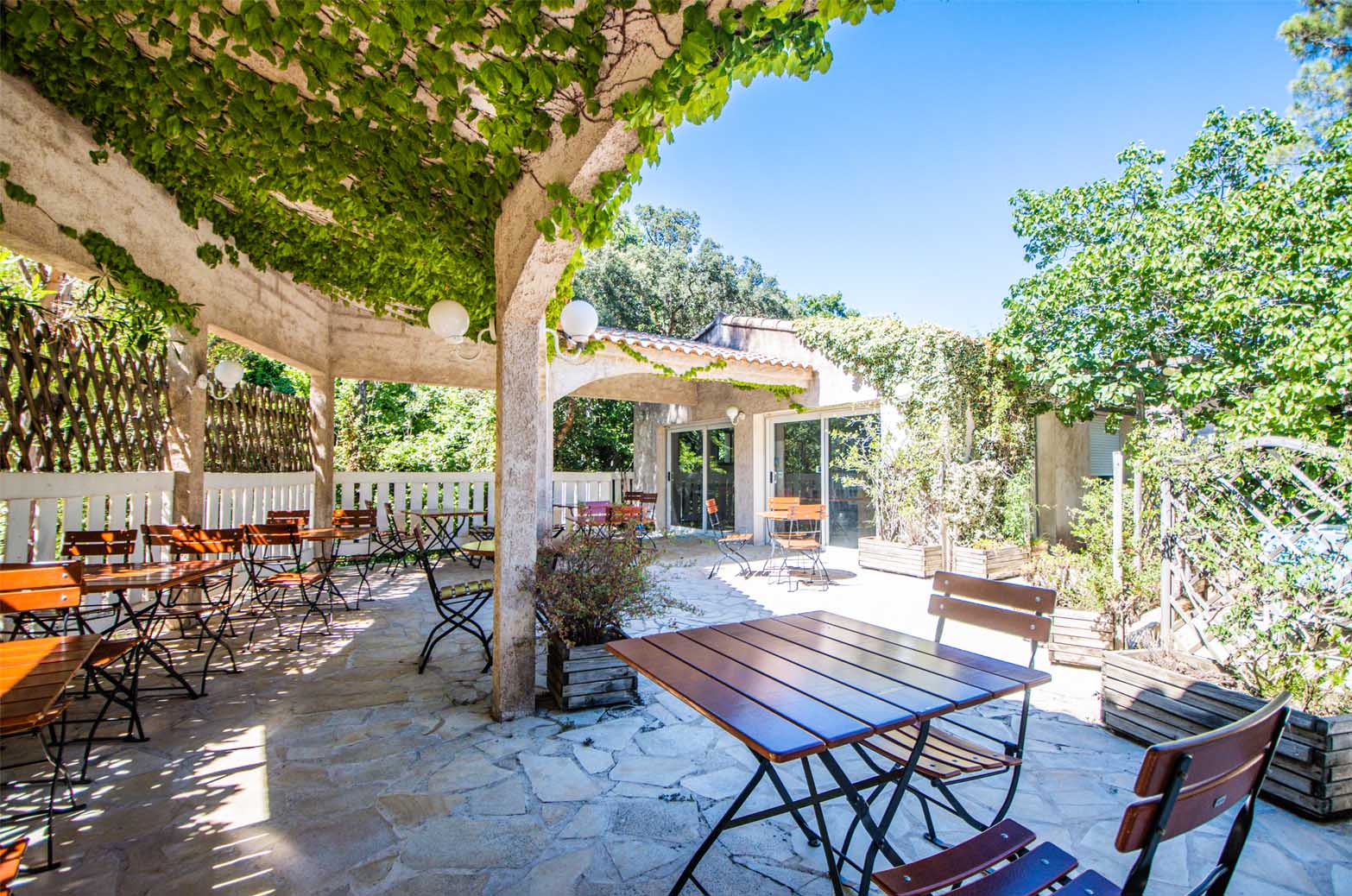
South Corsica, the jewel of the Mediterranean, offers an exceptional setting for camping enthusiasts. With its fine sandy beaches and majestic mountains, this region attracts many visitors every year in search of authenticity.
This guide presents a selection of the finest campsites, to suit all tastes, for a unique experience in the heart of nature while enjoying modern comforts. Explore coastal sites and campsites nestled in the unspoilt hinterland!
Seaside campsites: between fine sand and turquoise waters
South Corsica is renowned for its heavenly beaches and crystal-clear waters. For lovers of swimming and water sports, staying at a seaside campsite is a great option. Discover a selection of the region’s finest coastal campsites .
Camping de la Plage in Porto-Vecchio
Located just a few steps from the famous Palombaggia beach, Camping de la Plage offers direct access to the sea. The pitches, shaded by umbrella pinesto make the most of the Mediterranean atmosphere.
The campsite also offers comfortable mobile homes for those looking for a little more comfort. This campsite has a lot to offer, not least an ideal location close to Porto-Vecchio’s most beautiful beaches.
It boasts modern facilities, including a swimming pool and children’s play areas. Campers particularly appreciate its cleanliness and the quality of its services. What’s more, high-season entertainment creates a warm atmosphere, appreciated by young and old alike.
Camping U Paradisu in Propriano
Nestled in a green setting overlooking the Gulf of Valinco, Camping U Paradisu offers panoramic sea views. This exceptional site combines the charm of a natural campsite with the comfort of modern facilities.
This campsite stands out for its spacious , well-defined pitches , offering a pleasant setting. It also offers access to a small private cove and quality facilities, including a swimming pool with sea views. Camping U Paradisu has everything you need for an unforgettable stay, combining nature and comfort.
What’s more, our proximity to Propriano means that campers can easily take advantage of the shops and entertainment on offer in this charming seaside resort. Hiking enthusiasts will no doubt appreciate the many trails accessible from the campsite.
So many seaside campsites offering a unique experience, combining the pleasures of the beach with those of camping. That said, for those who prefer the ambience of Corsica’s hinterland, there are other equally attractive options.
Inland campsites: immersion in Corsican nature
Thehinterland of southern Corsica is a treasure trove for nature lovers. Campsites in these areas offer a different experience, more focused on discovering Corsican mountain landscapes and traditions.
Camping A Casetta in Zonza
Located in the heart of the Alta Rocca, the A Casetta campsite is a haven of peace for nature lovers. Surrounded by mountains and laricio pine forests, this campsite offers an idyllic setting to recharge your batteries and enjoy the wild beauty of the island.
Highlights of this campsite include spacious, shaded pitches and a nearby river, ideal for cooling off. What’s more, it offers easy access to the hiking trails of Corsica’s regional nature park.
Its central location makes it the perfect base for exploring picturesque villages and immersing yourself in authentic Corsican culture.
Camping Les Oliviers in Sartène
Despite its proximity to the coast, Les Oliviers has a typical Corsican hinterland feel. Set in a century-old olive grove, this campsite combines rustic charm with modern comfort. Among the assets of this campsite are :
- pitches shaded by magnificent olive trees;
- a swimming pool and leisure facilities for the whole family;
- the proximity of Sartène, nicknamed “the most Corsican of Corsican townsthe most Corsican of Corsican towns“.
The least we can say is that this campsite is particularly appealing to families in search of peace and quiet. And it’s all within easy reach of the region’s tourist attractions.
These campsites in the hinterland allow you to discover another facet of southern Corsica, far from thehustle and bustle of the seaside resorts. They offer a more intimate and authentic experience, ideal for reconnecting with nature.
Choosing the ideal campsite: criteria and advice
Selecting the perfect campsite for your vacation in South Corsica means taking a number of criteria into account. We have a few tips to help you make the right choice.
Essential criteria
When choosing your campsite, there are several things to consider:
- location: seaside or inland, depending on your preferences;
- Facilities: swimming pool, playground, on-site grocery store, etc. ;
- type of accommodation: bare pitch, mobile home or bungalow;
- Services on offer: entertainment, equipment rental, etc.
It’s important to define your expectations and needs before making your choice. For example, if you’re traveling with your family, a campsite with activities for children will be more suitable. On the other hand, if you’re looking for peace and quiet, a smaller, less busy campsite might be more suitable.
Book at the right time
Southern Corsica is a very popular destination, especially in summer. So it’s a good idea to book your stay as early as possible, especially if you’ve set your sights on a popular campsite. Here are a few tips:
- for a July-August stay, book early in the year;
- For less busy periods (May, June, September), booking 2 to 3 months in advance may suffice;
- please do not hesitate contact the campsite directly for availability and special offers.
By booking in advance, you’ll have more choice and may be able to take advantage of special rates.
Activities not to be missed during your camping holiday
A camping holiday in Southern Corsica is the ideal opportunity to discover the region’s natural and cultural riches. Here are a few must-do activities for your vacation:
Water sports and seaside activities
South Corsica is renowned for its magnificent beaches and crystal-clear waters. Take advantage of the many water sports on offer:
- swimming, of course, in the turquoise waters of the Mediterranean;
- snorkeling, to observe the underwater flora and fauna;
- sea kayaking, ideal for exploring inaccessible coves by land ;
- scuba diving, for the more adventurous.
These are just some of the activities available to make the most of the exceptional Corsican coastline. Don’t forget to ask at your campsite, as many offer equipment hire or partnerships with local service providers.
Discovering the hinterland
The inland areas of southern Corsica are a treasure trove of places to explore:
- hiking, with many marked trails for all levels;
- visits to hilltop villages that bear witness to Corsican history and culture;
- discover local gastronomy in traditional inns and restaurants.
These activities offer a different perspective on Corsica, far from the crowded beaches. They allow you to immerse yourself in the local culture and discover breathtaking landscapes.
Conclusion
South Corsica offers a wealth of camping options, both on the coast and inland. Each site has its own special features, allowing you to find the ideal campsite. Find out about the facilities and services on offer, and book well in advance, especially in high season.
Take advantage of your stay to explore the natural and cultural riches of this region, from swimming to hiking and gastronomic discoveries. Your camping vacation is sure to be unforgettable!